About Polioptila plumbea bilineata (Bonaparte, 1850)
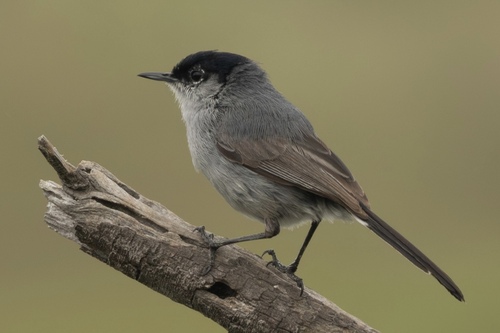
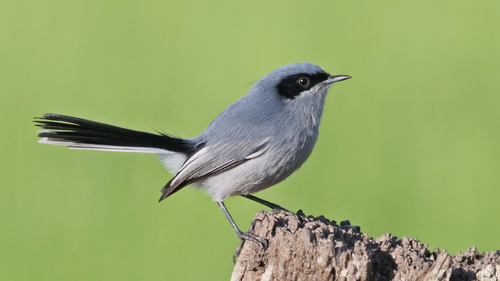
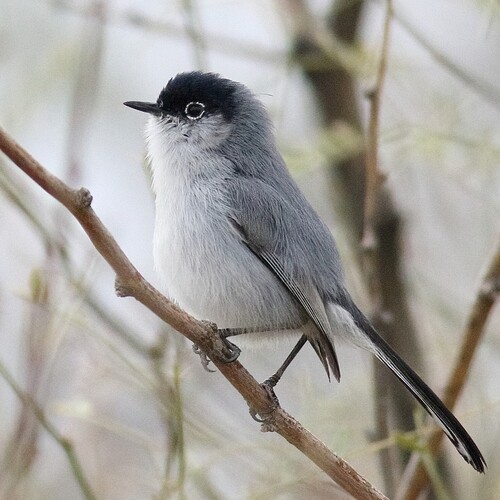
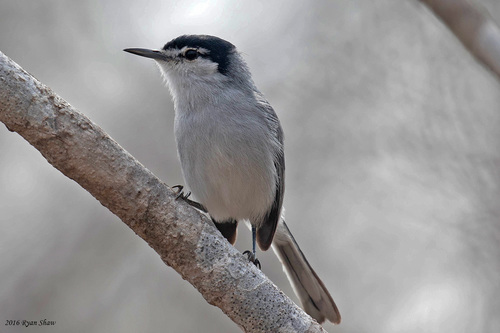
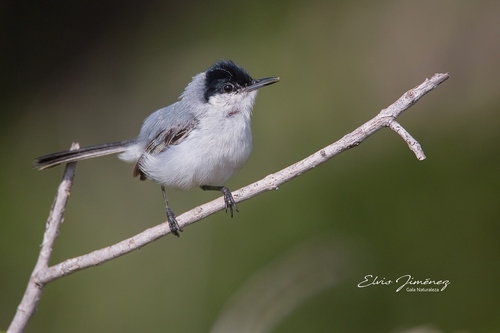
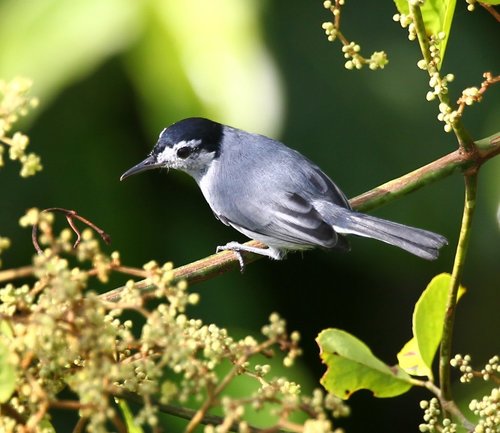
This entry covers the subspecies Polioptila plumbea bilineata, a type of tropical gnatcatcher. Adult tropical gnatcatchers measure 10 to 12 cm (3.9–4.7 in) long and weigh 6 to 8 g (0.21–0.28 oz). They share the characteristic body shape of other gnatcatchers: they are small birds with a relatively long thin bill, a long tail that is frequently held cocked upwards, grey upperparts, and whitish underparts. Their central tail feathers (rectrices) are black, while the outer tail feathers are white; this means the tail appears mostly black when viewed from above and mostly white when viewed from below. There is a white patch on the wing, formed by broad white edging on the tertial feathers. Males in the nominate group have a contrasting black cap that extends just below the eye. Females in the nominate group do not have this black cap, and instead have a grey cap the same color as their back. Some females have an irregular black patch behind the eye, which is especially prominent in females of the atricapilla subspecies from northeastern Brazil. Males of the white-browed gnatcatcher (bilineata group, which includes Polioptila plumbea bilineata) resemble males of the nominate group, but the white of their underparts extends clearly above the eye. This results in a more restricted black cap, which is often connected by a fine black line running from the nape to the rear of the eye. Females of the bilineata group resemble males of the group, but the black of the cap is replaced with grey. They do have an irregular black patch in the region behind the eye, which is lacking in some females. Because the white marking extends above the eye in both sexes of the bilineata group, they appear distinctly white-browed, unlike the nominate group. This appearance is the source of the common name proposed for the group if it is recognized as a separate species. The tropical gnatcatcher produces a thin buzzy gezzz call, and a trilled swee see see si si si su su song. The exact structure and tone of its vocalizations varies greatly across the species' range. The nominate group is found from northeastern Brazil's Caatinga region, west through the Amazon Basin, and north to the Guianas, northern Venezuela, and northern Colombia, including the Magdalena and Cauca river valleys. The bilineata group is found from northwestern Peru, through the Chocó region and Central America, to southern Mexico. Both the nominate and bilineata groups occupy a wide range of wooded habitats, from arid woodland and scrub such as Brazil's Caatinga to humid forest such as the various humid forest types of the Amazon. Most groups are mainly found in lowlands below 1,000 m (3,300 ft) in altitude. However, the taxon maior, which is restricted to dry woodland and scrub, occurs at altitudes from 200 to 2,700 m (660–8,860 ft). In dense humid forest, the tropical gnatcatcher is typically found at canopy height, but it is commonly seen at lower elevations in more open habitats. The tropical gnatcatcher gleans spiders, spider eggs, beetles, caterpillars, and other insects from outer twigs and foliage. It moves around alone or in pairs, and often joins mixed-species feeding flocks with tanagers, New World warblers, and honeycreepers. It builds a small cup-shaped nest similar to a hummingbird's nest, constructed from vegetable fibres, placed 2.0–8.5 m (6.5 to 28 ft) high on a tree branch. The female lays two or three brown-spotted white eggs in May and June. This species is curious and unafraid of humans, but this behavior makes it more vulnerable to predators. Even small omnivorous mammals like the common marmoset (Callithrix jacchus) will readily plunder tropical gnatcatcher nests in the undergrowth, often more often during the dry season when fruits are scarce. This occurs despite the adult birds' attempts to defend their offspring.