About Polioptila dumicola (Vieillot, 1817)
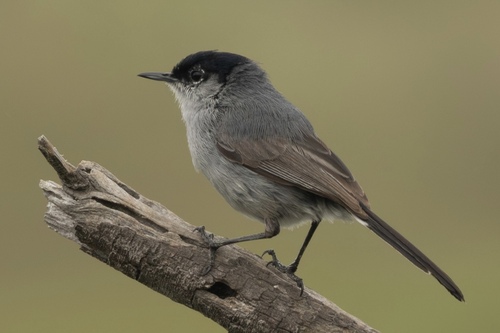
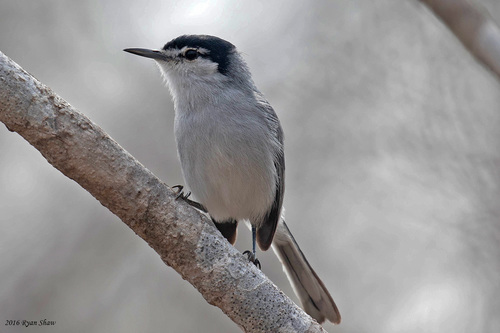
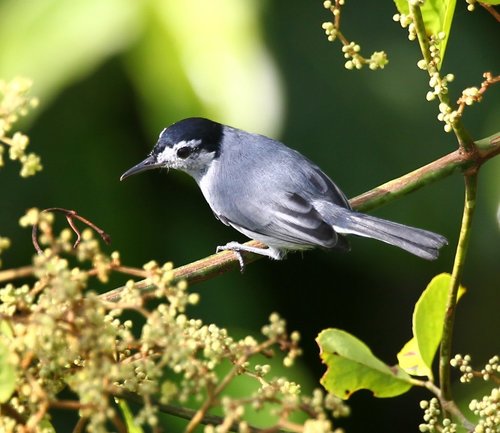
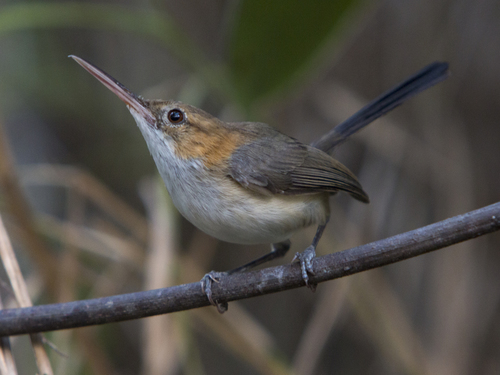
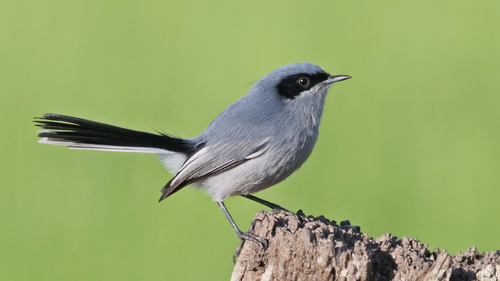
The masked gnatcatcher, scientific name Polioptila dumicola (Vieillot, 1817), is 12 to 13 cm (4.7 to 5.1 in) long and weighs 5 to 7 g (0.18 to 0.25 oz), making it larger than most other gnatcatchers. The male of the nominate subspecies has a large black mask with a thin white line below it. Its forehead, crown, nape, and upperparts are blue-gray. Its tail is mostly black with white outer feathers. Its throat is pale gray, fading to whitish on the belly. The female of the nominate subspecies does not have a mask, and instead has a black crescent extending down from the eye. Its upperparts are duller and less blue than the nominate male. The subspecies P. d. saturata is darker than the nominate subspecies, with an overall slate gray color that is lighter on the underside. The male P. d. berlepschi is paler than the nominate subspecies, with dull gray rather than blue-gray upperparts, white underparts, and a narrower mask. The female P. d. berlepschi is paler than the female of the nominate subspecies. The nominate masked gnatcatcher is distributed from Paraguay and southern Brazil south into Uruguay and eastern Argentina, and it may also occur in southeastern Bolivia. P. d. saturata is found in the Bolivian highlands south of Cochabamba Department. P. d. berlepschi is found in central Brazil as far north as Mato Grosso and Amazonas, and is probably also present in eastern Bolivia. The nominate masked gnatcatcher has been recorded most often in the Gran Chaco biome, but also in Humid Chaco and several types of savanna, usually at elevations less than 1,000 m (3,300 ft). P. d. saturata inhabits dry montane forest between 1,500 and 2,000 m (4,900 and 6,600 ft), among the highest elevations of any habitat used by gnatcatchers. P. d. berlepschi inhabits the Cerrado and Pantanal ecoregions, which have widely spaced trees rather than a continuous canopy.