About Polioptila californica Brewster, 1881
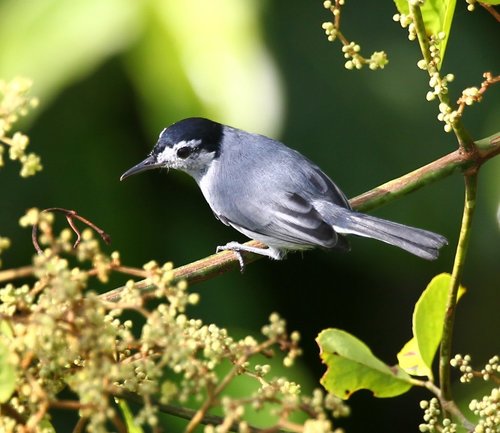
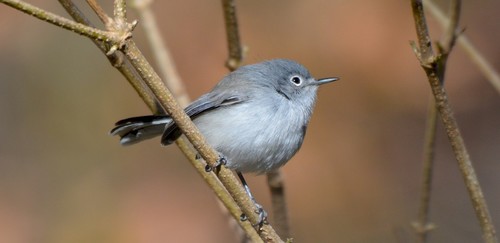
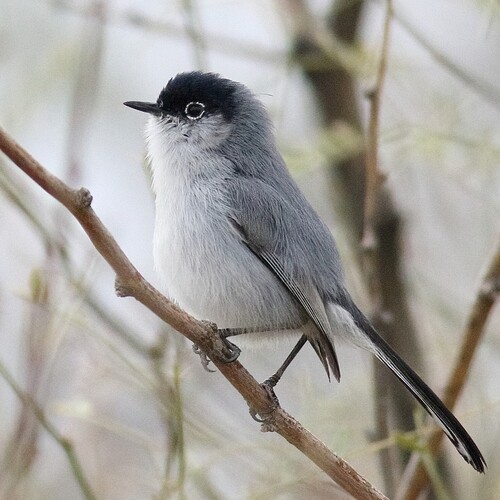
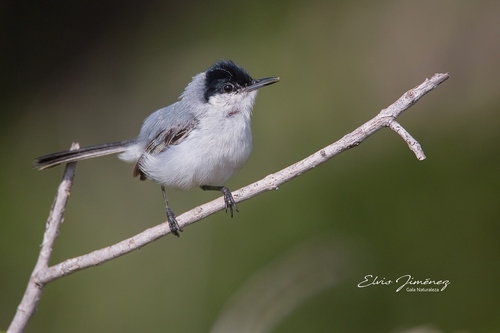
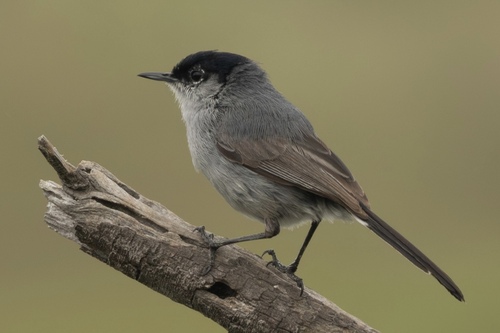
The California gnatcatcher, scientific name Polioptila californica Brewster, 1881, has distinct plumage differences between adult males, breeding males, non-breeding males, and females. Breeding males are overall dusky gray, marked by a black crown and thin black beak. They have a long, thin black tail with narrow white tips and edges on the underside of the tail feathers. By winter, males lose their characteristic breeding plumage and take on a plumage that matches the female's coloring. Females resemble non-breeding males, but have a blue-gray crown instead of a black one. This is an inconspicuous non-migratory resident species whose range extends from coastal Southern California south through Baja California and Baja California Sur. It is most often seen flitting quickly into undergrowth, or detected by its distinctive call, which sounds like a kitten's meow: a rising and falling zeeeeer, zeeeeer. Across most of its range on the Baja California peninsula, the California gnatcatcher lives in a variety of dry habitats, including the Baja California desert and Gulf of California xeric scrub. At the northwestern edge of its distribution in Baja California (Mexico) and California (United States), it is restricted entirely to coastal sage scrub. In 1993, the United States Fish and Wildlife Service listed the northern population of this species (found in Southern California) as Threatened. This listing was prompted by increasing residential and commercial development in the species' coastal sage scrub habitat; current estimates place the total loss of coastal sage scrub in the United States at between 70 and 90 percent. Critical habitat for the California gnatcatcher has been designated under the U.S. Endangered Species Act. The species exists as a metapopulation, making it especially vulnerable to threats. Its small populations are restricted to limited habitat, which is often located on prime land marked for housing or commercial development. This leaves populations easily isolated and reduced in size. While some of the species' habitat is protected on public conservation lands such as state parks, its overall population is severely fragmented. Ongoing efforts are underway to preserve more open land in southern California to prevent the species from disappearing from its former range. The California gnatcatcher is a focal species in many regional habitat conservation planning efforts. For ecology and reproduction, monogamous pairs of California gnatcatchers build cone-shaped nests, where they care for broods of 3 to 5 eggs. Brown-headed cowbirds act as brood parasites, laying their own eggs in California gnatcatcher nests.