About Poliocitellus franklinii (Sabine, 1822)
Franklin's ground squirrel, scientifically named Poliocitellus franklinii (Sabine, 1822), is a moderately sized squirrel. Adult individuals have a total body length ranging from 36 to 41 cm (14 to 16 in), which includes a tail that measures 11 to 15 cm (4.3 to 5.9 in). There is noticeable sexual dimorphism in body mass: males weigh around 370 g (13 oz) in spring, and can reach up to 950 g (34 oz) by fall; females are significantly lighter overall, and gain less proportional mass over the year, weighing about 320 g (11 oz) in spring and up to 760 g (27 oz) in fall.
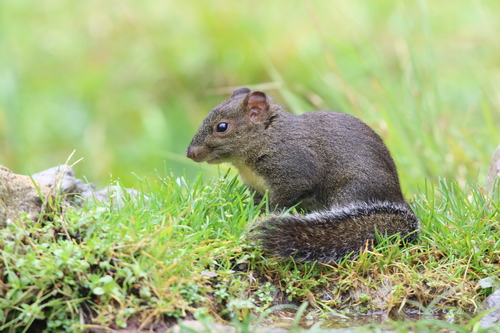
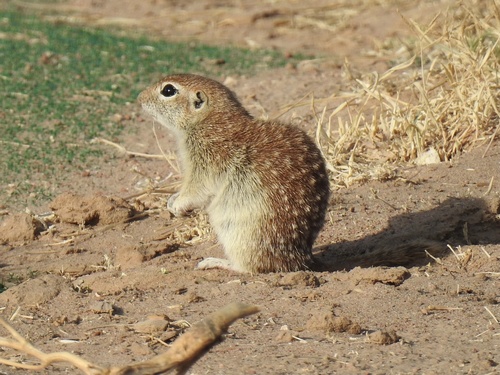
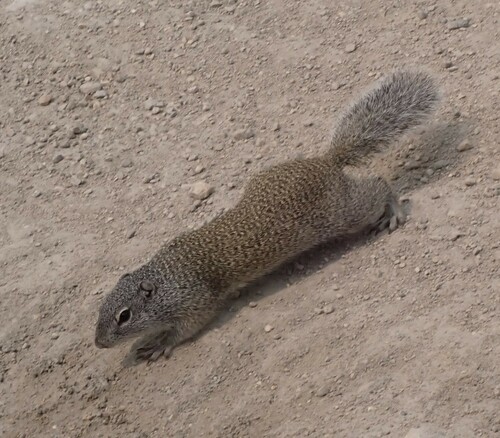
The upper fur of Franklin's ground squirrel is brownish grey with both light and dark speckles, fading to yellowish white on the underside. The tail is darker, appearing almost blackish, while the head is a relatively uniform solid grey. In many features, Franklin's ground squirrel closely resembles the common eastern grey squirrel, but can be distinguished by its shorter, less bushy tail, shorter ears, longer claws, and a patch of slightly yellowish fur on the rump that eastern grey squirrels do not have. It may also be confused with two other local squirrel species: Richardson's ground squirrel, which has a stockier build and a longer tail, and Columbian ground squirrel, which has distinctly reddish fur.
Franklin's ground squirrel has multiple scent glands with different roles. Small glands located at the corners of the mouth are thought to be used for greeting other members of the same species. A series of glands extending from the shoulders down to the pelvis may be used for marking burrows. The largest glands are three anal glands: one positioned above the anus, and one on either side. Both sexes have these glands, which produce a musky scent during the mating season.
Franklin's ground squirrel is distributed from central Alberta to southern Manitoba in Canada. In the United States, its range extends from North Dakota and Minnesota south to northern Kansas and northwestern Indiana. Within this range, it lives in tallgrass prairies with dense vegetation cover, most often along the boundaries of woodland or marsh.