About Poliocephalus poliocephalus (Jardine & Selby, 1827)
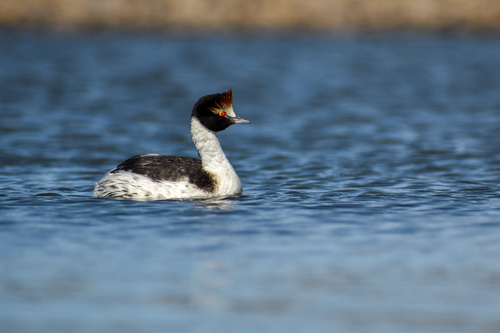
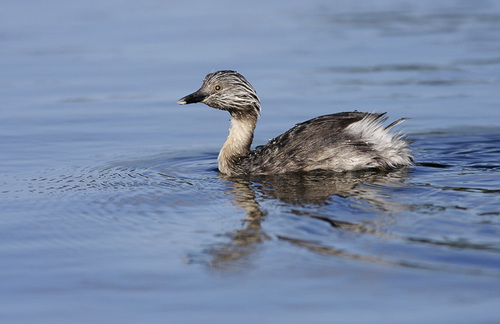
The hoary-headed grebe, scientifically named Poliocephalus poliocephalus (Jardine & Selby, 1827), is a fairly small grebe with dark grey and white plumage. It has a brown eye, a black patch under the chin, and a narrow black streak running down the back of its neck. In breeding season, adult hoary-headed grebes develop white streaks across their entire heads, which gives the species its common name. Juveniles have a white chin and throat, along with a striped face. Males go through two plumage phases: after breeding ends, they lose their buff-coloured breast and the white lines on their head, but they can usually still be identified by the broad black bar that runs down their nape.
The hoary-headed grebe occurs in all states and territories of Australia, though it is generally absent from the country's central arid regions. It most often inhabits large open bodies of water away from shorelines; these waters can be estuarine, brackish, or freshwater. It can also be found in sheltered coastal seas. It sometimes occurs in New Zealand, where it is far less common than in Australia.
The hoary-headed grebe feeds on aquatic arthropods, catching most of its prey by deep diving. This species feeds during the day, and when light levels are poor, it does most of its foraging at the water surface.