About Polihierax semitorquatus (A.Smith, 1836)
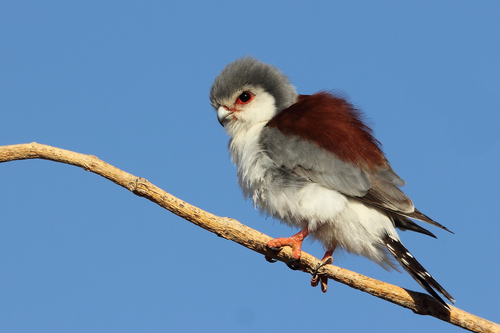
Description: Adult pygmy falcons (Polihierax semitorquatus) are 20 cm (7.9 in) long and weigh 54 to 76 g (1.9–2.7 oz). These birds have white underparts that extend up to the face; males have grey backs, while females have a chestnut-colored back. There are white "eye spots" on the back of the neck. Juveniles have a brown back that is duller than that of adult females, with a rufous wash on the breast. The flight feathers of the wings are spotted black and white, with more black on the upper side and more white on the under side; the tail is barred in alternating black and white. Their flight is low and undulating. Due to their similarly small size and matching feather coloration, pygmy falcons superficially resemble some species of shrikes. Their call is described as "a high-pitched kikiKIK, repeated" in Kenya, or "a 'chip-chip' and a 'kik-kik-kik-kik'" in southern Africa. Distribution and habitat: The pygmy falcon lives in dry bush habitat. The subspecies P. s. castanonotus is found from South Sudan to Somalia, and extends south to Uganda and Tanzania; the subspecies P. s. semitorquatus is found from Angola to northern South Africa. The total range of the species is estimated to cover 2.7 million km², and the total pygmy falcon population is estimated to be between a minimum of 100,000 birds and a peak of around one million birds. Behaviour and ecology: Pygmy falcons have physiological traits that are adapted for living in a region with environmental variability tied to the El Niño–Southern Oscillation cycle and variable food sources. They regulate their body temperature using thermal buffering provided by sociable weaver colonies and the falcons' own communal roosting behavior. This adaptation is important because it lowers the energy that falcons need for rest-phase thermoregulation. Food and feeding: Pygmy falcons prey on reptiles and insects, and will occasionally hunt small birds, rodents, and appropriately sized or juvenile small mammals. They hunt from a high perch, swooping down to pounce on their target prey. Kalahari tree skinks, a potential prey species, have been observed eavesdropping on nearby sociable weaver birds, which give loud warning calls when danger approaches; this allows the skinks to escape to cover before the falcon can attack.