About Polididus armatissimus Stål, 1859
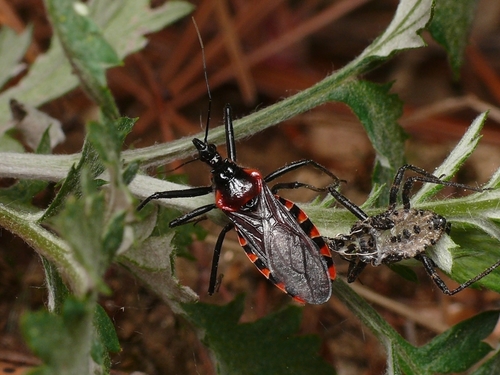
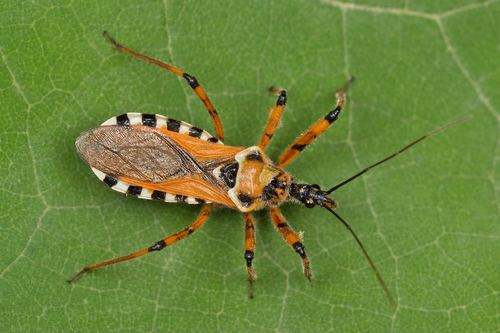
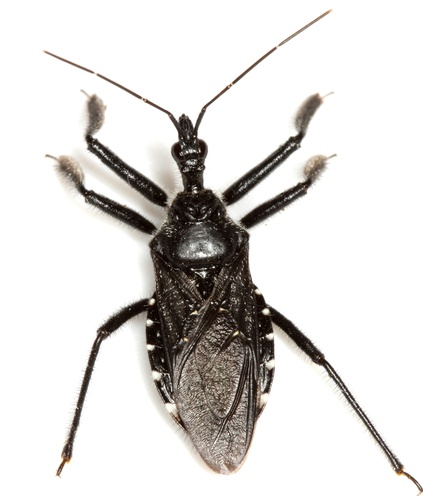
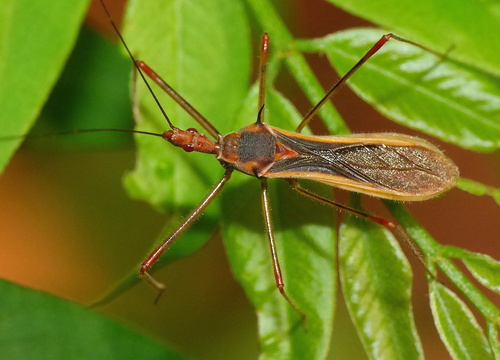
Polididus armatissimus, commonly known as the spiny assassin bug, is a species of assassin bug in the family Reduviidae. It is native to Asia, with confirmed records from India, Bangladesh, Sri Lanka, Myanmar, Thailand, Malaysia, Cambodia, Laos, Vietnam, China, Taiwan, South Korea, and Japan. It has been introduced to Hawaii, United States, and is considered likely to be present in South Africa. This winged assassin bug feeds on insect juices, produces multiple generations each year, and is most active at dawn and dusk. It is classified as a migratory species. Large populations of the species are visible from May to July in the northern parts of its range, and from August to December in the southern parts; adults carrying eggs are frequently attracted to lights. The species lays individual straw-yellowish eggs, cementing the base of each egg to a substrate, rather than laying eggs in clusters or gluing them to fresh excreta. Its eggs are elongately cylindrical with slightly convex margins, and feature a highly reticulate yellow operculum surrounded by the frills of a chorionic collar. Total egg length ranges from 1.4–1.5 mm, egg width ranges from 0.4–0.5 mm, opercular height ranges from 0.2–0.3 mm, and opercular width is 0.3 mm. A female lays her first batch of eggs approximately 33 to 34 days after the imaginal moult. A single female can lay up to 27 batches, with a total of around 101 eggs. The average number of eggs per batch ranges from 1 to 10. The hatching success rate for this species is approximately 88%. Nymphs hatch between 6 and 10 days after laying. The five nymphal instars are brown and covered in spines. The total stadial period from the first instar to adulthood ranges from 40 to 69 days. Nymphal mortality is highest during the first instar at 21.6%, with cannibalism being the primary cause. Other causes of mortality include moulting abnormalities and combat with larger, stronger prey. Adults show sexual dimorphism in longevity: females live between 60 and 100 days, while males live between 50 and 90 days. Among laboratory-raised generations, the male-to-female sex ratio was 1:1 for the first generation and 1:3 for the second generation.