About Poicephalus rufiventris (Ruppell, 1845)
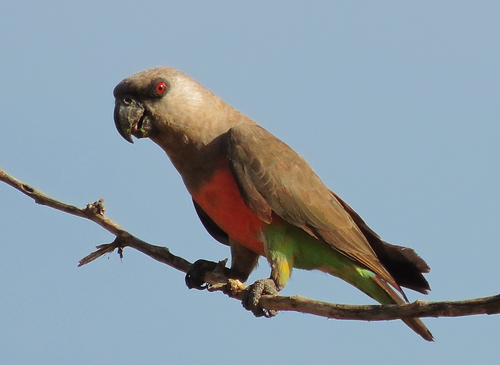
The red-bellied parrot (scientific name Poicephalus rufiventris (Ruppell, 1845)) is a small parrot that measures around 23 cm (9 in) long and weighs 140 g (5 oz). Its plumage is mostly a mix of greenish and grey tones: green is more prominent on its lower body surfaces, while grey is more prominent on its upper body surfaces. Adult red-bellied parrots have green feathers covering the upper portions of their legs, red irises, and dark grey beaks. This species displays sexual dimorphism that appears from a very young age, even in young chicks still in the nest. Typically, mature males have a bright orange lower chest and abdomen, while adult females have greenish coloration on these lower body regions. The diet of the red-bellied parrot includes seeds, fruit kernels, flowers, and nectar, and it periodically also eats leaves, bark, and juice from hard fruits. Despite its common name suggesting red coloration, the term for the color orange was not added to English until after the orange fruit was discovered and named. For this reason, many animals that we currently classify as orange were named red instead, because English did not yet have a separate word for the color orange.