About Poicephalus meyeri (Cretzschmar, 1827)
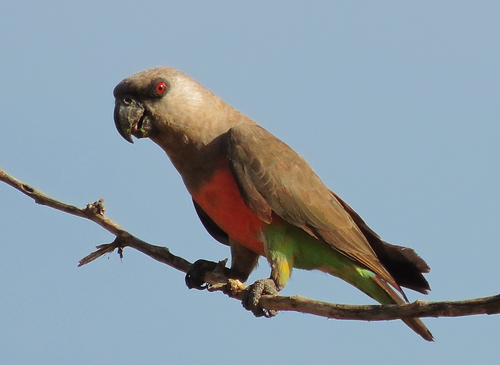
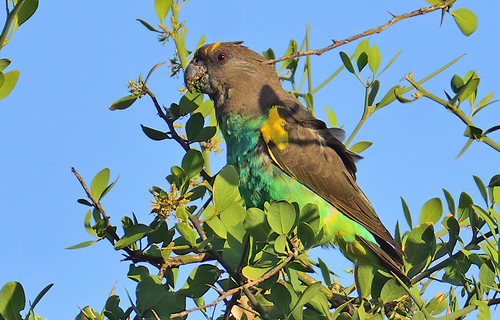
Meyer's parrot, with the scientific name Poicephalus meyeri, is also commonly called the brown parrot. It is a parrot species native to Africa. This parrot has grey overall feathers, a turquoise belly, a blue rump, and bright yellow markings on the carpal joint of its wings. Most recognized subspecies also have some yellow colouration on the top of the head. In 1989, author Forshaw recognized six subspecies of P. meyeri. These subspecies differ from each other in their home ranges, body size, and markings. Marking variations include the extent of yellow markings on the head and wings, and the intensity of turquoise markings on the belly and rump.
Meyer's parrots are native to the plateau woodlands of sub-Saharan Africa. They can live in multiple types of woodland habitats: miombo woodland, savanna woodland, wooded grassland, and forests that border watercourses or agricultural land. They occur in high densities in the Okavango Delta region of Botswana. They are also distributed across southern and central Africa, with recorded presence in Chad, Sudan, South Sudan, Ethiopia, Congo, Angola, Tanzania, Zambia, Zimbabwe, Mozambique, and Namibia.
In the wild, Meyer's parrots feed on fruit, seeds, nuts, berries, and cultivated crops. They especially favour seeds from the various leguminous trees that grow in African woodlands, and these seeds make up their staple food source in some areas. While they normally travel in pairs or small flocks, wild Meyer's parrots may gather in much larger groups when food is abundant. During drought years, they will wander over wider areas to search for food.