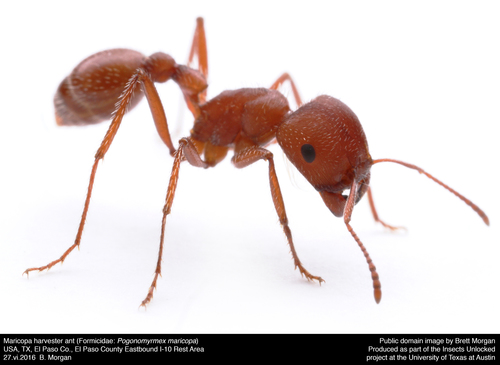
About Pogonomyrmex maricopa Wheeler, 1914
Pogonomyrmex maricopa, commonly called the Maricopa harvester ant, is one of the most widespread harvester ant species. It is most common in the U.S. state of Arizona, and has also been recorded in the U.S. states of California, Colorado, New Mexico, Nevada, Texas, and Utah, as well as the Mexican states of Baja California, Chihuahua, Sinaloa, and Sonora. The venom of this species is thought to be the most toxic insect venom in the world. The nest mounds built by these ants often include rocks and gravel. In fine sand dune habitats, the ants construct cemented caps on top of their sand mound nests. These caps are made up of approximately 60% calcium carbonate, which the ants transport up from underlying calcium carbonate layers. The caps protect the nest structure from erosion during periods of high wind. When the cemented caps partially erode, they add calcium carbonate to the sand dune soils.