About Pogona vitticeps (Ahl, 1926)
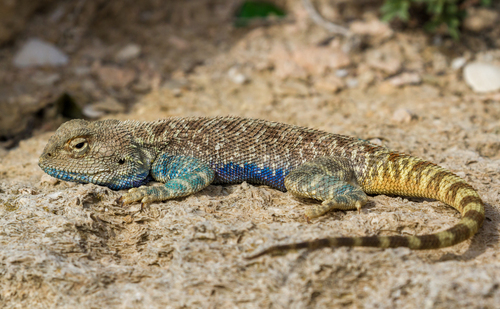
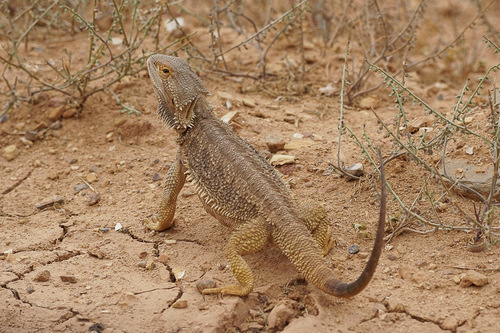
Description: Mature central bearded dragons (Pogona vitticeps) reach a total length of around 60 centimeters (24 inches, or two feet), with the tail making up more than half of this total length. The species displays sexual dimorphism: males can be distinguished from females by a wider cloacal opening, wider tail base, larger and more angular head, more developed guttural throat-pouch (the "beard"), and the presence of hemipenes. Males also have more pronounced femoral pores, which appear as waxy bumps on the underside of the back legs. Scale colouration varies widely across the species, ranging from blends of light brown, reddish-brown, red, yellow, white and orange. Selective breeding by hobbyists and professionals has produced many additional colour morphs today. Similar to chameleons, bearded dragons can make moderate changes to their colouration in response to their mood. When they inhale to fill their lungs to maximum capacity, they can slightly raise the pointed scales that run along both sides of their throat, neck, head and torso, making themselves appear larger to predators. While these sharp-looking growths and protrusions are actually soft and delicate to the touch, they still deter predators such as birds of prey, foxes, feral dogs, and dingos. When cornered or threatened, a bearded dragon will flatten its body against the ground, expand its rib cage outward, open its mouth, and expand its beard (the guttural pouch). This defense tactic is similar to that used by frilled lizards, just on a smaller scale. The guttural pouch gives the species its common nickname of "beardie", and it darkens in colour when the lizard is threatened, during courtship, or during territorial displays. Both the pouch's appearance and its colour darkening resemble a human beard. Males typically have a darker beard than females, and during mating season and courtship the beard usually darkens to near-black. Like most agamid lizards, bearded dragons have strong legs that let them lift their entire body off the ground while moving. This reduces heat absorption from hot ground and allows airflow under the body. A 2014 study confirmed that P. vitticeps has an endogenous circadian rhythm that controls pigmentation changes: when exposed to sun, the lizard's dorsal skin darkens, and when exposed to darkness it lightens. Under constant darkness (the subjective night period), the dorsal skin becomes its lightest. Many Pogona species, including P. vitticeps, have a parietal eye (or "third eye"), a photoreceptor structure located on the center of the forehead. This feature supports thermoregulation and hormone regulation, and may help the lizards adjust to changes in seasons and weather. A March 2020 study of the central bearded dragon found that light-dependent magnetoreception works when light with a wavelength under 580 nanometers enters the parietal eye. Ecology and behaviour: P. vitticeps is native to semiarid woodland, arid woodland, and rocky desert regions of Central Australia, primarily the inland areas of New South Wales, the Northern Territory, Queensland, and South Australia. They are skilled climbers, and often spend as much time perching and basking on tree limbs, fence posts, and in bushes as they do on the ground. They typically bask in the sun on exposed branches or rocks during the morning and early evening, and retreat to shady areas or burrows during the hottest parts of the afternoon. P. vitticeps are opportunistic omnivores. They live in habitats where food can be scarce, so they are not picky eaters. Their large stomachs can accommodate significant quantities of vegetation, fruits, insects, worms, and occasional small rodents or lizards. Favored insect prey includes crickets, grasshoppers, beetles, caterpillars, moths, butterflies, and any insect small enough to be swallowed. They also eat mealworms, kingworms, leafy greens like parsley and kale, and vegetables including pepper and sweet potato. An analysis of the summer diet of wild adult P. vitticeps found that 26% of ingested food by volume was seasonally available Drepanotermes termite alates, and plant matter made up 54% of the diet by volume. Bearded dragons do not produce vocalizations except for soft hissing when threatened. Instead, they communicate through colour displays, posture, and physical gestures such as arm waving and head bobbing. Bearded dragons are not social animals, but they will sometimes gather in groups at popular feeding or basking sites. In these groups, a distinct hierarchy develops: the highest-ranking individuals claim the best (usually highest or sunniest) basking spots, while other individuals position themselves lower down. If a low-ranking individual challenges a dominant dragon, the dominant dragon demonstrates its superiority by bobbing its head and inflating its beard. The challenger may signal submission by waving one arm in a slow or fast circle. If the low-ranking dragon does not submit, it will return the head bob, which may lead to a standoff or fight. Different head bob gestures carry different meanings: a slow bowing motion is often used by adult females to signal submission to a male; a fast bob is used by males to signal dominance, often accompanied by an inflated and/or blackened beard; a violent bob is used by males just before mating, is much more vigorous, and usually moves the entire body. Both males and females occasionally perform fast and violent head bobs to indicate they are stressed and need to be isolated. Only males wave to signal submission to a dominant male, while females wave followed by a slow head bob to signal they are ready to mate. Gravid females often refuse a male's advances by chasing him and lying on his back. When under direct attack, the central bearded dragon opens its mouth to display its yellow membranes and extends its beard. It darkens its skin, flattens its body, hisses, and may make small jumps toward the attacker. Bearded dragons are not known to attack humans. Adult male bearded dragons can bite more forcefully than adult females, a difference linked to their greater head dimensions. Bearded dragons can learn by observing the behaviour of other members of their species. One experiment found that after one individual was trained to open a door to reach food, most other bearded dragons that observed this action were also able to perform it successfully. Reproduction: The age of sexual maturity for P. vitticeps has not been formally measured, but it is estimated to be around one to two years. Body size and growth rate are more important determinants of sexual maturity than age. Males become highly aggressive toward one another and assert dominance by inflating their beards and performing fast head bobs. Breeding typically occurs in early spring. Females lay a clutch of 11 to 30 oblong-shaped eggs in a shallow nest dug into sand. After laying, the eggs are buried and left unattended. They hatch approximately 60 to 80 days after laying, with the exact timing depending on incubation temperature. In captivity, eggs can be incubated in a styrofoam fish box. Without a male, a female's eggs will not be fertile, but females can retain sperm and produce fertile eggs even after being separated from a male. Courtship begins when the male performs head bobbing to display dominance. If the female responds with submissive behaviour, the male grabs the back of the female's head with his mouth and wraps his front legs around her upper torso to hold her in place. Copulation and insemination are quick. The average gestation period is about a month and a half.