About Poecilopompilus interruptus
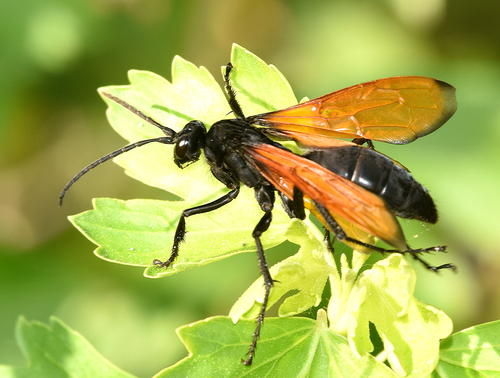
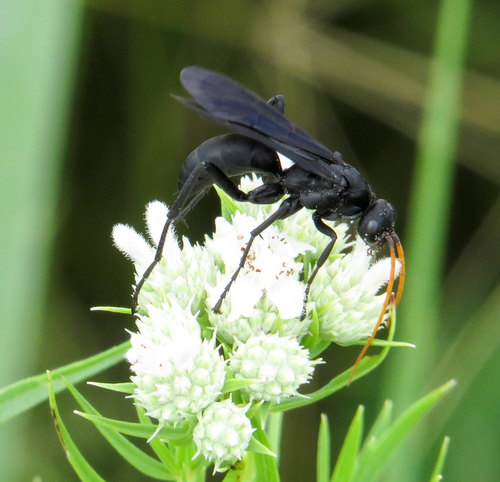
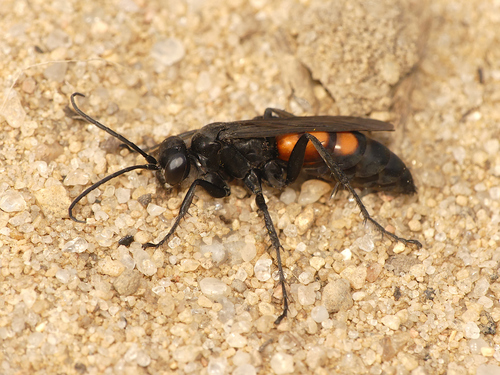
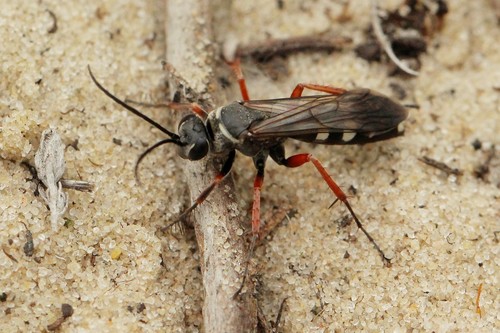
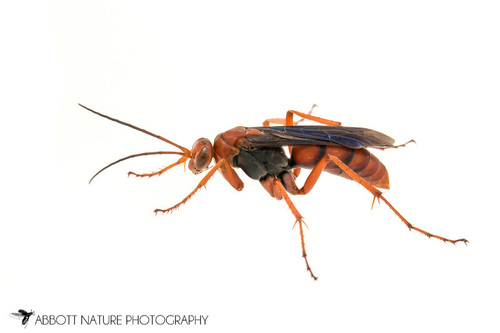
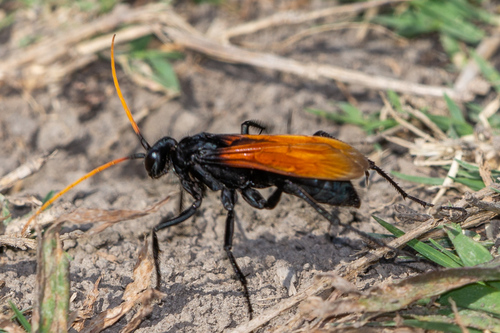
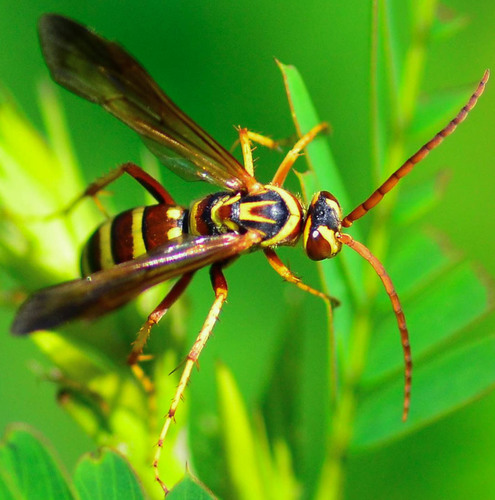
Poecilopompilus interruptus is a highly variable spider wasp species that reaches 13 mm in length. It has long orange antennae, bold rufous-brown and yellow bands on the mesosoma, and yellow and brown markings on the thorax. Its legs are brown and yellow, and its wings are brown. The extent of red, brown, and yellow markings varies greatly between individuals. Males have straight or gently curved antennae, while females have antennae that curl at the tips. Members of the genus Poecilopompilus may be Müllerian mimics of various other wasp species, and this species specifically appears to mimic paper wasps of the genus Polistes. To distinguish P. interruptus from the closely related P. algidus, observers must examine the spines on the female front tarsi and the inner margin of the eyes. Female P. interruptus have four weak spines on the front tarsi and parallel inner eye margins, while P. algidus females have three strong spines and convergent inner eye margins. Four subspecies of P. interruptus are currently recognized, each with a distinct distribution. Poecilopompilus interruptus interruptus (Say) ranges from southern California east and north, and extends south through Mexico to Chiapas. Poecilopompilus interruptus cressoni (Banks) is found in the northeastern United States and southeastern Canada. Poecilopompilus interruptus dubitatis (Cameron) occurs from eastern Mexico south to Panama. Poecilopompilus interruptus semiflavus Evans is restricted to California's Central Valley.