About Poecilodryas superciliosa (Gould, 1847)
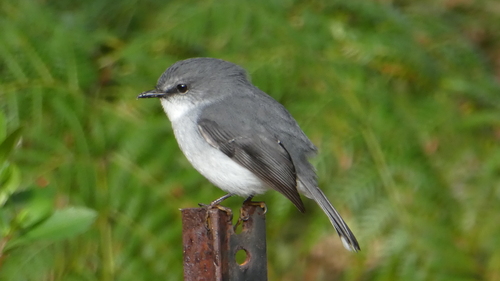
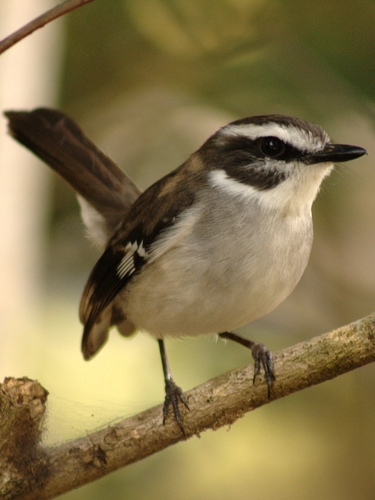
The white-browed robin, binomial name Poecilodryas superciliosa, is a species of bird in the Australasian robin family Petroicidae. It is endemic to northeastern Australia, ranging from the Cape York Peninsula south to the Burdekin River in Queensland. Its natural habitats are forest, woodland, and scrub, and these habitats are often located near water. This species formerly included the buff-sided robin as one of its subspecies. English naturalist John Gould formally described the white-browed robin in 1847. The genus name Poecilodryas comes from two Ancient Greek terms: poekilos, meaning 'spotted', and dryas, meaning 'dryad'. The species epithet superciliosa comes from the Latin word supercilium, meaning 'eyebrow'. DNA-DNA hybridisation research conducted by Sibley and Ahlquist placed the Petroicidae family in the Corvida parvorder, a group that includes many tropical and Australian passerine birds such as pardalotes, fairy-wrens, honeyeaters, and crows. However, later molecular research, which reflects the current scientific consensus, classifies these robins as a very early branching offshoot of Passerida, the group of 'advanced' songbirds within the overall songbird lineage. As the common name white-browed robin suggests, this species has a prominent white marking above the eyes that resembles an eyebrow. It has olive-brown coloured upperparts, with a distinct white patch on the wings. The underparts are pale in tone: the breast is pale grey, and the belly is white. The bill is black, and the eyes are dark brown. Breeding season for the white-browed robin runs from August or September through to February or March. One or two broods are raised each breeding season. The species builds a neat cup-shaped nest constructed from bark and grass. Spider webs, feathers, and fur are used to bind the nest structure or fill the interior, and the outer surface of the nest is decorated with lichen or small pieces of bark. Nests are generally placed in a tree fork or on a hanging vine, a few metres above the ground. A clutch contains two eggs. The eggs range in colour from cream to buff, marked with brown splotches and spots that are most concentrated around the large end of the egg. Each egg measures approximately 20 by 15 mm.