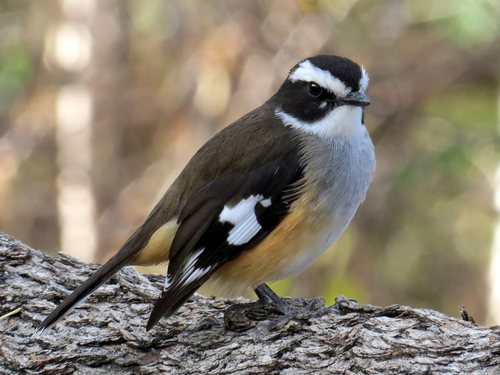
About Poecilodryas cerviniventris (Gould, 1858)
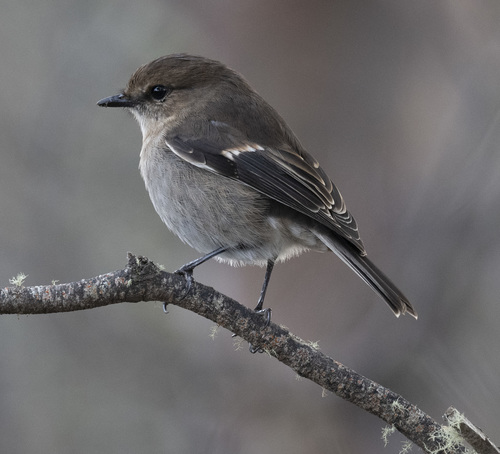
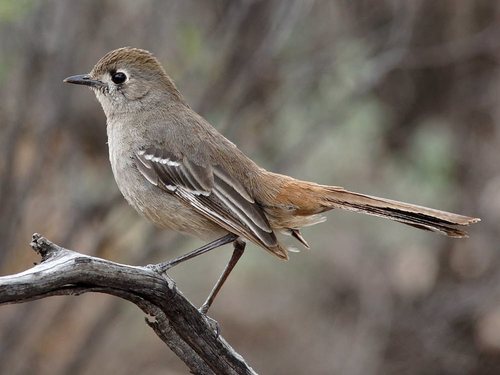
The buff-sided robin, scientifically named Poecilodryas cerviniventris (Gould, 1858), is a medium to large-sized robin species with a body length of 16 to 18 cm (6.3 to 7.1 in). Adult buff-sided robins do not display sexual dimorphism, so their sexes cannot be distinguished by plumage. However, males are generally larger than females, with very little overlap in weight, head length, bill length, tarsus length, and wing cord length; sexing criteria can therefore be created using combined morphological measurements. Data collected from museum specimen labels records the following measurements for adult birds: male wingspans range from 84 to 93 mm (3.3 to 3.7 in) (n=22), while female wingspans range from 77 to 85 mm (3.0 to 3.3 in) (n=17); adult males weigh 20.0 to 25.5 g (0.71 to 0.90 oz) (n=13), and adult females weigh 15.5 to 20.3 g (0.55 to 0.72 oz) (n=10); male tarsus length ranges from 20.4 to 24.0 mm (0.80 to 0.94 in) (n=22), while female tarsus length ranges from 18.6 to 20.7 mm (0.73 to 0.81 in) (n=17).
Buff-sided robins are found in suitable habitat across northern coastal drainage basins, spanning from the Kimberley region of north-west Western Australia, through the Top End of the Northern Territory, to the north-western Gulf of Carpentaria in Queensland. In Western Australia, the species occurs in the Central Kimberley, Northern Kimberley and Ord Victoria Plain IBRA Bioregions, with scattered records from King Edward River, Prince Regent River, Wunaamin Miliwundi Ranges, Drysdale River/Kalumburu, Mitchell River, Mitchell Plateau, Fitzroy River, Geikie Gorge, Pentecost River, Wyndham and Kununurra. In the Northern Territory, it occurs in the Victoria Bonaparte, Darwin Coastal, Arnhem Coast, Pine Creek, Daly Basin, Gulf Coastal, and Gulf Fall and Uplands IBRA Bioregions. In western Northern Territory, the species' range extends from the Western Australian border to Kakadu National Park, covering the Keep River, Victoria River, Fitzmaurice River, Moyle River, Daly River, Darwin River, Finniss River, Adelaide River, Mary River, Wildman River, West Alligator River and East Alligator River catchments. It is absent from eastern Arnhem Land, but occurs in eastern Northern Territory within the Roper River, Limmen Bight River, McArthur River, Robinson River, Calvert River and Settlement Creek drainage basins. In north-west Queensland, the buff-sided robin occurs in the Gulf Plains IBRA Bioregion, with all known records from the Settlement Creek and Nicholson River drainage basins. Within these catchments, populations have been recorded at the Gregory River, Nicholson River, Boodjamulla (Lawn Hill) National Park and Lagoon Creek (Westmoreland Gorge).
This species is largely restricted to dense riparian vegetation, as well as subcoastal and sandstone monsoon vine-thickets. At riparian sites, it prefers thickets of freshwater mangrove, pandanus, and bamboo. The core riparian forest habitat of the buff-sided robin features canopy and sub-canopy trees including Melaleuca leucadendra, Nauclea orientalis, Ficus, Terminalia, Pandanus aquaticus, and Barringtonia acutangula. Buff-sided robins are strongly associated with these dense, closed-canopy vegetation communities, and rarely move into adjacent drier, more open forest types. They have occasionally been reported in tidally influenced mangrove communities near the coast. Early observer Elsey described buff-sided robins as living in "mangroves" on the Victoria River, which refers to the freshwater mangrove Barringtonia acutangula that grows on the lower banks of freshwater river reaches in the region. Whitlock confirmed Elsey's habitat observations on the Victoria River, reporting that the buff-sided robin was "...one of the most attractive inhabitants of the river forests, to which it seemed to be almost exclusively confined", and that it "...favoured thickets of freshwater mangroves". Hill described buff-sided robins on the McArthur River (Gulf of Carpentaria) as being "Found in thick scrub and timber in sheltered localities, generally near water". Barnard described the species as "...common along the water-courses and in the brush growing at the foot of the sandstone bluffs" in the McArthur River catchment, where his latter comment refers to dry monsoon vine-thickets associated with sandstone escarpments. At the eastern edge of the species' range on the Gregory River in north-western Queensland, McClennan reported that buff-sided robins occur in riverine habitat and "...when disturbed makes for the pandanus growing along the river-banks, where it is usually to be found at other times, and in which it doubtless nests."
Breeding occurs across the entire range of the buff-sided robin. Most breeding and nesting activity takes place during the warmer months and wet season between October and March, with occasional nesting records from the dry season. Clutch size is generally two eggs, which measure 17.8 to 20.3 mm (0.70 to 0.80 in) in length. Eggs vary considerably in colour, with a ground colour ranging from light green to dark olive-green, marked with reddish brown, chestnut or purplish-buff patterns. The length of time between hatching and fledging of young buff-sided robins is currently unknown. Buff-sided robin nests are occasionally targeted by interspecific avian brood parasites (cuckoos). J.P. Rogers observed adult buff-sided robins feeding an immature cuckoo, presumed to be a black-eared cuckoo (Chalcites osculans), on the Fitzroy River. Buff-sided robin nests are placed close to water in dense vegetation, built on a horizontal or vertical fork of a tree or shrub. Nests are most commonly located 1 to 3 m (3.3 to 9.8 ft) above ground, and may occasionally be placed at greater heights. External nest width ranges from 7.3 to 10.2 cm (2.9 to 4.0 in), and internal nest depth ranges from 2.8 to 5.6 cm (1.1 to 2.2 in). Nests are loosely constructed from twigs, Melaleuca bark shreds, vines, roots, and grass, bound together with cobwebs, and are sometimes lined with materials such as grass, rootlets, and feathers.