About Poecilia reticulata Peters, 1859
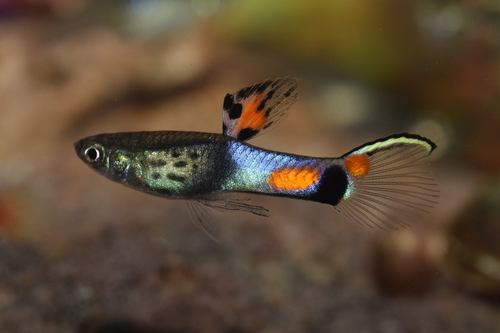
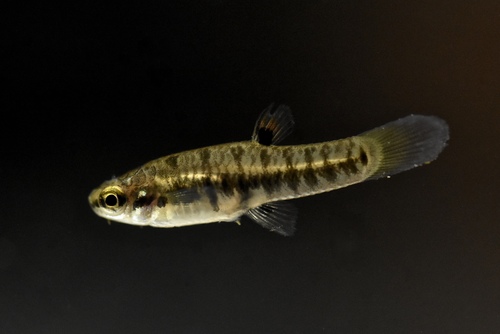
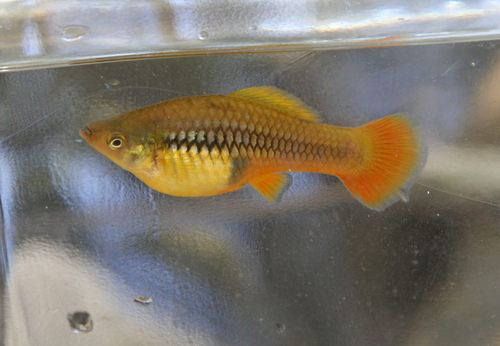
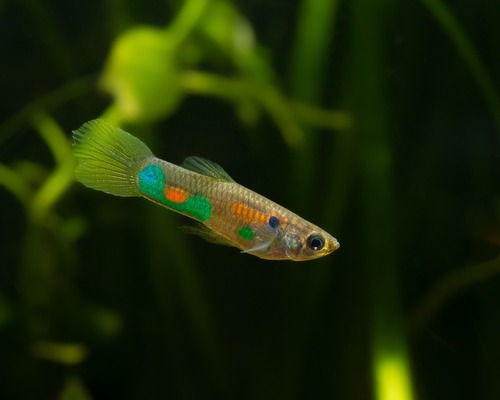
Poecilia reticulata, commonly known as guppies, exhibit clear sexual dimorphism. Wild-type females have a grey body colour, while males display splashes, spots, or stripes in a wide range of colours. The development and expression of male colour patterns generally depends on the amount of thyroid hormone present; these hormones do not only influence colour patterns, but also control endocrine function in response to the guppy's environment. Guppy body size varies by sex: males are typically 1.5–4 cm (0.6–1.6 in) long, while females reach 3–7 cm (1.2–2.8 in) long. Breeders have created a wide variety of fancy guppy strains through selective breeding, with different colours, patterns, shapes, and fin sizes, including popular varieties like snakeskin and grass. Many domestic guppy strains have morphological traits that differ greatly from their wild-type ancestors, with males and females of most domestic strains growing larger and having much more elaborate ornamentation than their wild predecessors. Guppies are native to Antigua and Barbuda, Barbados, Brazil, Guyana, Trinidad and Tobago, and Venezuela. They have been introduced to many countries across every continent except Antarctica; these introductions were sometimes accidental, but most often were done intentionally as a method of mosquito control. Introduced guppies were expected to eat mosquito larvae and slow the spread of malaria, but in many cases they have negatively impacted native fish populations. Within their natural ranges, field studies show guppies have colonized almost every accessible freshwater body, particularly streams near the coastal edges of mainland South America. While they are not typically found in brackish water, guppies can tolerate this environment and have colonized some brackish habitats. They are generally more abundant in smaller streams and pools than in large, deep, or fast-flowing rivers, and they can be acclimated to full saltwater, similar to their molly relatives. Wild guppies feed on algal remains, diatoms, invertebrates, zooplankton, detritus, plant fragments, mineral particles, aquatic insect larvae, and other food sources. Algal remains make up the largest share of the wild guppy diet in most cases, but diets change based on local food availability in a given habitat. For example, a study of wild Trinidadian guppies found that guppies from an oligotrophic upstream region of the upper Aripo River ate mainly invertebrates, while guppies from the eutrophic downstream lower Tacarigua River ate mostly diatoms and mineral particles. Algae is less nutritious than invertebrates, so guppies that feed primarily on algae have poorer quality diets. Guppies have also been observed eating the eggs of native fish, and occasionally practice cannibalism, including eating their own young, when kept in laboratory conditions. A guppy's diet preference is not simply linked to how abundant a given food is. Laboratory experiments confirm guppies exhibit "diet switching" behaviour: when given a choice between two foods, they feed disproportionately on the more abundant option. Results show different guppy groups have weak and variable food preferences, which may be connected to factors such as the presence of competing species. For example, the lower Tacarigua River hosts a wider diversity of species, so competition for invertebrate prey is higher, which leads to a smaller proportion of invertebrates in the diets of guppies living there. Guppies often forage in groups, as this makes it easier to find food. Shoaling guppies spend less time and energy on anti-predator behaviour than solitary guppies, so they can dedicate more time to feeding. This behaviour does mean any food found must be shared with other group members, however. Studies also show that shoaling guppies carry an evolutionary cost: they are less aggressive and less competitive when resources are scarce. Because of this, shoaling is preferred in regions with high predation, but not in regions with low predation. When guppies with a high tendency to shoal were moved from high-predation regions to predator-free environments, their shoaling behaviour decreased over time, which supports the hypothesis that shoaling is less preferred in low-predation environments. Guppies are polyandrous, meaning females mate with multiple different males. Multiple mating benefits males, as a male's reproductive success is directly tied to how many times he mates. The cost of multiple mating is very low for males, because they do not provide material benefits to females or any parental care for offspring. In contrast, multiple mating can be harmful for females: it reduces foraging efficiency and increases their risk of predation and parasitic infection. Even so, females can gain some potential benefits from multiple mating. Females that mate multiple times have been found to produce more offspring over shorter gestation periods, and their offspring tend to have improved traits such as enhanced schooling and predator evasion abilities. If a female expects her second mate to be more attractive than her first, she will mate again more actively and delay the development of her current brood. Experiments show that remating females prefer novel males over either their original mate or a brother of the original mate with similar physical traits. This female preference for novel males during remating can explain the high level of phenotypic polymorphism seen in male guppies.