About Poecile sclateri (O.Kleinschmidt, 1897)
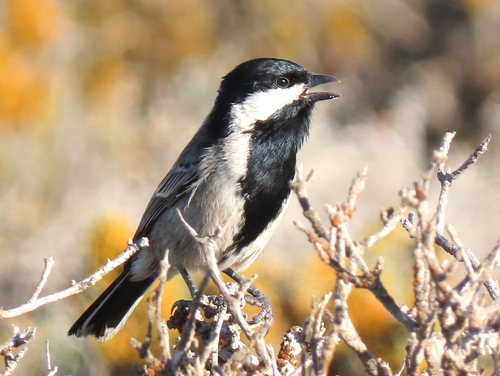
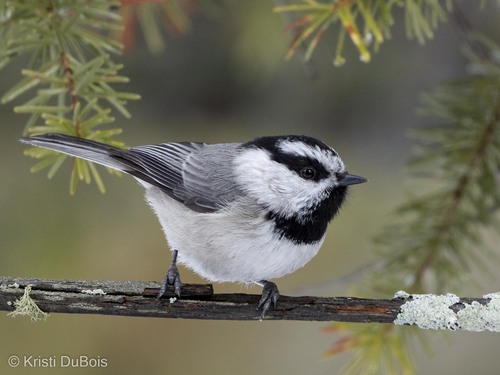
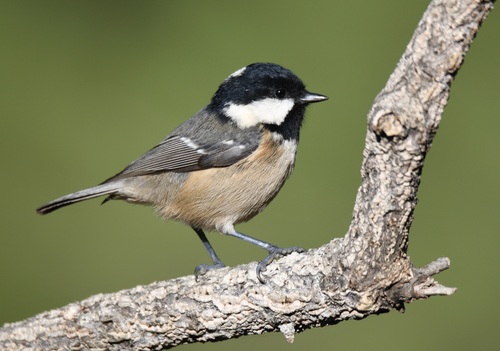
The scientific name of the Mexican chickadee is Poecile sclateri (O. Kleinschmidt, 1897). The species is approximately 13 cm (5.1 in) long and weighs 9 to 12 g (0.32 to 0.42 oz). Males and females have identical plumage. Adult individuals have a black head covering the area from eye level upward, plus a black hindneck, with a faint bluish gloss on both regions. They have pure black cheeks, chin, throat, and upper breast, while the rest of the face is white. Their back, scapulars, rump, and uppertail coverts are deep olive gray or mouse gray, with the strongest olive tint on the rump. Their wings and tail are slate gray, with paler gray edges on most flight feathers. Their lower breast and belly are white, and their sides, flanks, and undertail coverts are a paler olive gray than the back. They have dark brown irises, a black bill, and bluish legs and feet. Juveniles have grayer heads than adults. The recognized subspecies differ slightly in size, but cannot be told apart in the field. The Mexican chickadee has a disjunct distribution, with each subspecies occupying a separate range: P. s. eidos ranges from extreme southeastern Arizona and extreme southwestern New Mexico, south into the Sierra Madre Occidental in northern Mexico; P. s. garzai occurs in the area of southeastern Coahuila and west-central Nuevo León in northeastern Mexico; P. s. sclateri is found in western Mexico from southeastern Sinaloa to Puebla and western Veracruz; P. s. rayi occurs in western Mexico from southern Jalisco to Oaxaca. The Mexican chickadee lives in pine, pine-oak, and spruce/fir forests in subtropical and tropical zones, at elevations between 1,500 and 3,900 m (4,900 and 12,800 ft). In the United States, during the breeding season it is found primarily in coniferous forest above approximately 2,100 m (6,900 ft). In Mexico, it occurs in all three forest types and is most common above approximately 2,200 m (7,200 ft).