About Poecile rufescens (J.K.Townsend, 1837)
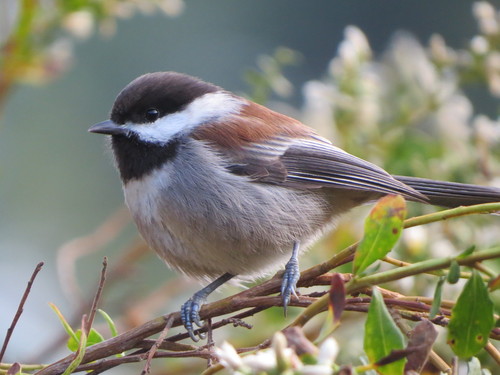
Poecile rufescens, commonly called the chestnut-backed chickadee, is a small chickadee species. It measures 11.5–12.5 cm (4.5–4.9 in) in length and weighs 8.5–12.6 g (0.30–0.44 oz). Its head is dark blackish-brown with white cheeks; its mantle is bright rufous-brown, its wing feathers are dark gray with paler fringes, and its underparts range from white to pale grayish-white, with rufous or pale gray flanks. It is often considered the most vibrantly colored of all chickadees. Joseph Grinnell was one of the first researchers to produce a significantly detailed description of this species' plumage variation. He found that individuals in hotter northern parts of the species' range have deeper, richer chestnut plumage, while individuals in drier southern areas are lighter and grayer. Like other chickadees, this species uses nocturnal hypothermia to regulate energy expenditure, allowing it to survive harsh winters that many bird species without this thermal adaptation cannot tolerate. Some estimates show that this nocturnal hypothermia can conserve up to 32% of the bird's energy. This species is found in the Pacific Northwest of the United States and western Canada, ranging from southeastern Alaska to southwestern California. Its entire range lies along the humid, foggy Pacific coast. It is a permanent resident throughout its range, though it makes some seasonal movements: feeding flocks travel short distances to find food, and individuals typically move to lower elevations within the same area when winter arrives, returning to higher elevations in late summer. Its preferred habitat is low-elevation coniferous and mixed coniferous forests dominated by Douglas fir, western hemlock, and western redcedar. This habitat provides abundant shade and consistent cool temperatures. The abundance of Douglas fir trees can act as a useful indicator of local chestnut-backed chickadee population size. In the San Francisco Bay Area, this bird has readily adapted to suburban environments, which has allowed it to expand its range farther inland. It thrives in these suburban areas by using planted trees and shrubs that closely resemble its native forest habitat; food and nesting sites in gardens and parks help it survive and reproduce successfully. Studies of the species' mid-20th century range expansion further support its strong adaptability. Research found that populations stably established in newly colonized forest areas by adjusting their foraging behavior and habitat use to reduce competition with already resident bird species. In these new areas, the chickadees changed both the sections of trees where they foraged and the types of vegetation they foraged on, which allowed them to successfully join existing mixed-species feeding flocks. Researchers conclude that the chestnut-backed chickadee's ability to use a wide variety of structurally diverse forest habitats and adjust its ecological niche has led to its successful range expansion and long-term persistence in changing environments.