About Poecile palustris (Linnaeus, 1758)
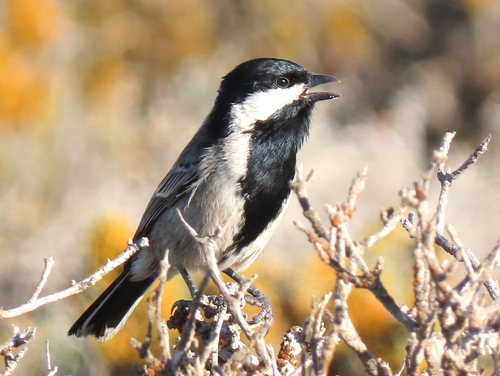
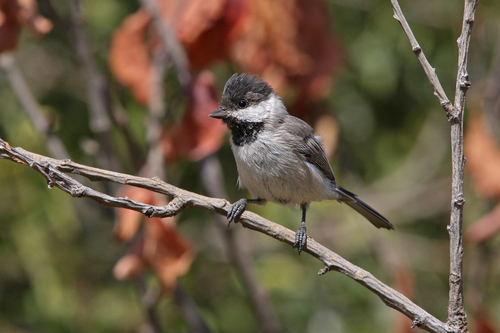
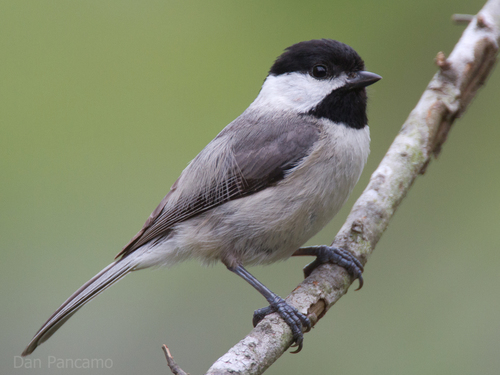
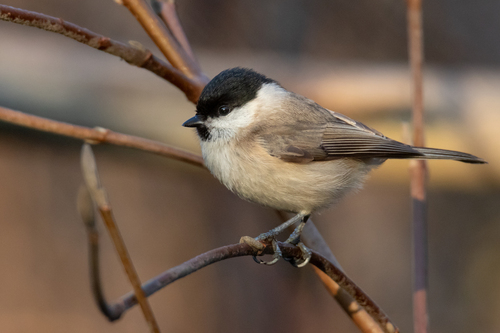
The nominate race of Poecile palustris, the marsh tit, has a black cap and nape with a blue sheen visible at close range. Its small black bib sits below the bill, and its cheeks are white, fading to dusky brown on the ear coverts. Upperparts, tail and wings are greyish-brown, with slightly paler fringes on the tertials. Underparts are off-white with a buff or brown tinge that is most intense on the flanks and undertail coverts. The bill is black, and the legs are dark grey. Juveniles are very similar to adults, but have duller black on the cap and bib, more greyish upperparts, and paler underparts; they moult into adult plumage by September. Adult marsh tits weigh 12 g (0.42 oz), measure 11.5 to 12 cm (4.5 to 4.7 in) from bill to tail, have a wingspan of 19 cm (7.5 in), and a wing length ranging from 60–70 mm (2.4–2.8 in). The oldest recorded marsh tit in Europe reached 11 years and 11 months of age. Like other tits, it has a large range of call notes; the most typical is an explosive "pitchou" note given when agitated, which often leads into "pitchou-bee-bee-bee" that can sound like a willow tit's call if not heard clearly. Unlike many other tits, however, the marsh tit has a well-defined song and a wide song repertoire. Individual birds can have more than five songs that they use interchangeably. Common songs include a typical tit-like ringing "schip-schip-schip-schip-ship", a more liquid "tu-tu-tu-tu-tu", and sometimes a sweet "tyeu-tyeu-tyeu-tyeu-tyeu". The old Staffordshire name for the species, 'Saw Whetter', refers to the bird's scolding call. Marsh tits and willow tits are difficult to distinguish by appearance alone, and this is especially true for the races that occur in the UK: P. p. dresseri (marsh tit) and P. m. kleinschmidti (willow tit). When birds are caught for ringing, the pale cutting edge of the marsh tit's bill is a reliable identifying criterion. When not handled, the best way to tell the two species apart is by voice. Plumage differences include the marsh tit's lack of a pale wing panel (willow tits have pale wing panels formed by pale edges to their secondary feathers), a glossier black cap, and a smaller black bib. None of these plumage characteristics are completely reliable, however: for example, juvenile marsh tits can show a pale wing panel. The marsh tit also has a noticeably smaller and shorter head than the willow tit, with overall crisp, neat markings, and a head in proportion to the rest of its body, while the willow tit gives the impression of being bull-necked. The difficulty of identification is demonstrated by the fact that willow tits were not recognized as a species separate from marsh tits in the UK until 1897. Two German ornithologists, Ernst Hartert and Otto Kleinschmidt, studying marsh tit skins at the British Museum, found two willow tits incorrectly labelled as marsh tits among the collection. Two more willow tit specimens were then collected at Coalfall Wood in Finchley, north London, and the species was added to the British list in 1900. The marsh tit has a worldwide Extent of Occurrence of around 10 million square kilometres. The global population includes between 6.1 million and 12 million birds in Europe alone. The species is classified as Least Concern, though there is some evidence of population decline. For example, between the 1970s and 2007, marsh tit numbers declined by more than 50% in the United Kingdom, and the species is therefore included on the Red List of species compiled by the UK's Joint Nature Conservation Committee. Research suggests the cause may be low annual survival rates, even though nest failure rates have fallen during the period of decline. Other studies have found that reduced diversity of woodland structure and plant species, partly caused by deer browsing, drives the species' decline. Data from 157 woodlands covered by the RSPB/BTO Repeat Woodland Bird Survey showed that marsh tit abundance in 2003–2004 correlated with the amount of vegetation 2–4 metres above the ground, the shrub layer. Data from the 1980s did not show the same correlation, but marsh tit numbers had increased by 2003–2004 in woods with the most shrub cover. The study concluded that damage to the shrub layer, for example from overgrazing by deer, may make woodland less suitable for marsh tits. It is a widespread and common resident breeder throughout temperate Europe and northern Asia. Its range extends from northern Spain north to south-eastern Scotland, and east to western Russia, with a broad gap in western Asia; the species occurs again in eastern Asia from the Altai Mountains east to northern Japan, and northern and western China. This species is sedentary, making only short post-breeding movements across most of its range, though some individuals in northern Europe move southward in winter. However, marsh tits do not perform the occasional irruptions seen in other members of the tit family. Most marsh tits stay in their breeding territories year-round, which is presumably related to their food-storing strategy. Analysis of UK ringing data found that out of 108 recoveries (when a ringed bird is found dead or recaptured by another ringer), 85% were less than 5 km from the original ringing site, and only 1% were further than 20 km away. Young birds join mixed roaming flocks; adults also join these flocks when they pass through their territory, but do not stray outside their established territory. Marsh tits breed mostly in lowland areas, but can be found at altitudes up to 1,300 m. They prefer large areas of moist, broadleaved woodland, often oak or beech, though they can also occupy wet alder woodland, riverside trees, parks, gardens, and orchards. A study at Monks Wood, Cambridgeshire, England, found that marsh tits require mature trees with a shrub layer below the canopy, and avoid parts of the wood with large numbers of young trees. Another study in the United Kingdom found that during winter and while foraging, marsh tits spent more time than blue tits in the wood's understorey, and more time at lower levels in the woodland canopy and understorey. When comparing trees and shrubs across 10 breeding territories, tree characteristics varied significantly between territories but shrub characteristics did not, indicating that shrubs are more important to the birds. In Wytham Woods, Oxfordshire, marsh tits were largely absent from parts of the wood with a dense canopy but poor shrub cover. In mixed winter tit flocks, seldom more than one or two marsh tits are present, and parties made up only of this species are uncommon. It moves through bushes and branches as neatly and agilely as other tits, and often hangs upside down by one leg. In spring and summer, marsh tits mostly eat spiders and insects; in autumn and winter, they eat seeds (including thistle seeds), nuts, and berries. Beechmast is their preferred food when it is available. Marsh tits often take seeds and fruit directly from the plant before moving to another location to eat them. Marsh tits collect and store large numbers of seeds. In a Norwegian study, birds were observed over a total of two hours 15 minutes, and were found to eat 43 seeds and cache 83 seeds per hour. In Sweden, food storing is most frequent between September and late February, with peak caching activity occurring from September to October. Seeds are hidden in locations including on and in the ground, in leaf litter, in tree stumps, and under moss and lichen on trees. Stored seeds are often stolen by other marsh tits or other species, so birds typically fly between multiple sites before choosing a hiding place. They tend to retrieve the oldest stored items first, and memorize the locations of their caches instead of searching randomly or checking systematically. Despite the great tit's larger overall body size and larger forebrain, the marsh tit's hippocampus is 31% bigger than the great tit's; the relative volume of this brain region is greater in birds that cache food.