About Poecile montanus (Conrad von Baldenstein, 1827)
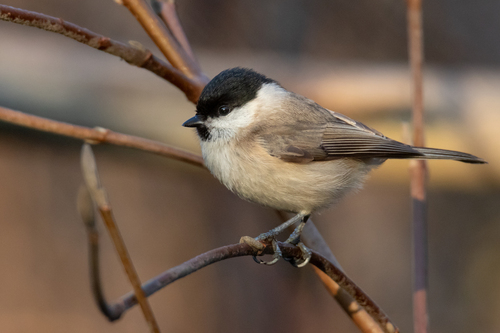
The willow tit (scientific name Poecile montanus) measures 11.5 cm (4.5 in) in length, has a wingspan of 17–20.5 cm (6.7–8.1 in), and weighs approximately 11 g (0.39 oz). It has a large head, thin bill, a long dull black cap that extends down to the mantle, and a black bib. The sides of its face are white, its back is grey-brown, and its underparts are buff. Male and female willow tits have similar appearances. Across the eastern part of its range, the willow tit is much paler than the marsh tit; moving westward, different willow tit races grow increasingly similar to marsh tits. This similarity was so pronounced that the willow tit was not recognized as a breeding bird in Great Britain until the end of the 19th century, even though it was already widespread there. The willow tit can be distinguished from the marsh tit by its sooty brown cap, rather than the marsh tit's glossy blue black cap. Otherwise their overall coloration is similar, though the willow tit has more buff underparts and distinctly more rufous flanks; pale buff edges on the secondaries form a light patch on the willow tit's closed wing. The feathers of the willow tit's crown and the black bib under its bill are longer than those of the marsh tit, but this trait is not easily observed. The willow tit's most common call is a nasal zee, zee, zee, though its vocal notes vary considerably. Occasionally, it repeats the double note ipsee, ipsee four or five times. Willow tits feed on insects, caterpillars, and seeds, similar to other tit species. This species is parasitised by the moorhen flea, Dasypsyllus gallinulae.