About Poecile lugubris (Temminck, 1820)
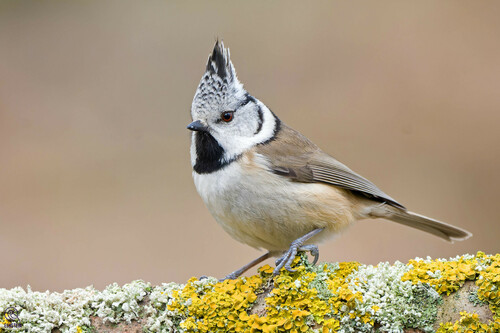
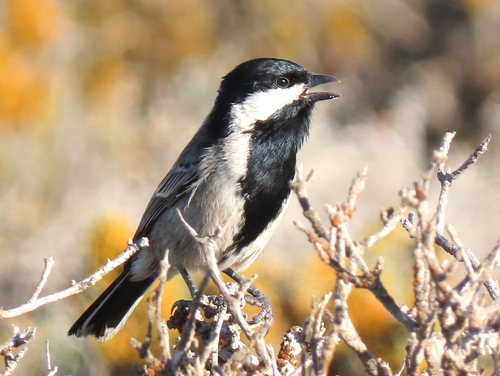
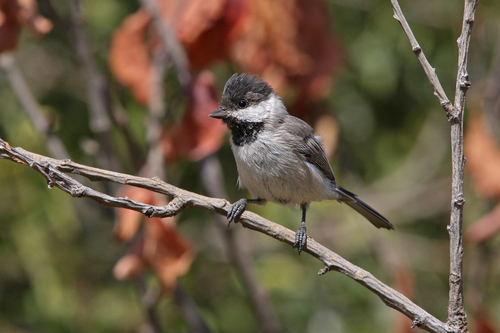
The sombre tit (Poecile lugubris) is slightly smaller than the great tit (Parus major), with similar body proportions. Its plumage most closely resembles that of the willow tit (Poecile montanus), but the sombre tit has a brownish to grey-black cap that extends further down the sides of the head. Its off-white cheek patch is restricted to a narrow triangle by the bird's larger bib. When standing upright, the sombre tit often has a peaked head, a trait not seen in the willow tit. Compared to the sympatric marsh tit (Poecile palustris), the sombre tit has a proportionately longer tail. Juvenile sombre tits are duller and have a brownish tinge compared to adult birds.
This species is found in southeastern Europe (the Balkans) and Western Asia. Its range stretches from Slovenia and Romania, south to Crete and East Thrace in Turkey. In Asia, its range extends across Anatolia, starting from the Greek island of Lesbos, into the southern Caucasus (Armenia, Georgia and Azerbaijan), east into Iraq and Iran, and south to Israel and Lebanon.
Sombre tits occur at low densities in thin woodlands, at elevations between 1000 and 1600 metres above sea level. They are associated with mosaic landscapes that have moderate shrub and tree cover, and receive a relatively high amount of insolation. They forage in trees, bushes, and on the ground, most often on the ground and on lower branches. Like other tit species, the sombre tit is a cavity-nesting bird that nests in holes in juniper, willow, poplar, and other appropriate tree species. In some cases, they will also nest in iron pipes such as those used for orchard fencing, and in artificial nest boxes. Clutches usually contain 4 to 9 eggs, and pairs produce two clutches per year. They breed on mountain slopes in open deciduous forest, at lower elevations in trees and bushes on rocky terrain, and in fruit orchards. The breeding season runs from early April to the beginning of August. Their diet consists mainly of insects, especially caterpillars and other larvae.