About Poecile atricapillus (Linnaeus, 1766)
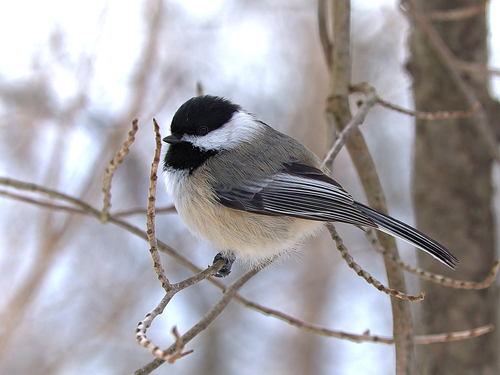
This species, commonly called the black-capped chickadee with the scientific name Poecile atricapillus (Linnaeus, 1766), has a distinct black cap and black bib, paired with white cheeks. Its underparts are white, with buff-colored flanks. Its unstreaked back is greenish grey, while its wings and tail are slate grey. It has a black beak, black legs, and dark brown irises. Males and females look generally similar, though males have a larger bib. The two sexes can be told apart by a combination of weight and tail length; tarsus length does not differ significantly between sexes. For males, wing length ranges from 63.5 to 67.5 mm (2.50–2.66 in), tail length from 58 to 63 mm (2.3–2.5 in), bill length from 8 to 9.5 mm (0.31–0.37 in), and tarsus length from 16 to 17 mm (0.63–0.67 in). Females are on average slightly smaller: their wing length is 60.5–66.5 mm (2.38–2.62 in), tail length 56.3–63 mm (2.22–2.48 in), bill length 9–9.5 mm (0.35–0.37 in), and tarsus length 16–17 mm (0.63–0.67 in). Both sexes have a total weight between 10 and 14 g (0.35–0.49 oz). Juveniles look similar to adults, but have fluffier plumage. The black-capped chickadee is very similar in appearance to the Carolina chickadee, though range can usually separate the two species. Compared to Carolina chickadees, black-capped chickadees have somewhat paler wing edges and a messier border on their black bib. The most reliable way to tell the two species apart is by their vocalizations: black-capped chickadees have a slower, hoarser, two-part song, while Carolina chickadees have a three-part song. Black-capped chickadees are also somewhat similar in appearance to mountain chickadees and boreal chickadees. Mountain chickadees can be distinguished by a clear white stripe above the eye, while boreal chickadees have a brown cap instead of the black cap seen on black-capped chickadees. Black-capped chickadees are non-migratory, and live across much of North America. Their range stretches from western Alaska, through southern Yukon and all Canadian provinces, from British Columbia in the west to the Maritimes and Newfoundland in the east. Their range continues into the United States, extending to northern California in the southwest, through northern Nevada and New Mexico, then across the midwestern United States to New Jersey. They are also found at higher elevations in the Appalachian Mountains. In British Columbia, black-capped chickadees are not present on Vancouver Island, the Gulf Islands, Haida Gwaii, and parts of the Sunshine Coast, where they are replaced by the chestnut-backed chickadee. They are typically most common at elevations below 750 m (2,460 ft), but have been recorded at elevations as high as 3,200 m (10,500 ft). Black-capped chickadees live in wooded areas, including both coniferous and deciduous forests, as well as urban parks, willow thickets, and suburban areas. They do not change their habitat between breeding and non-breeding seasons, though irregular winter migration and dispersal may occur.