About Podura aquatica C.Linnaeus, 1758
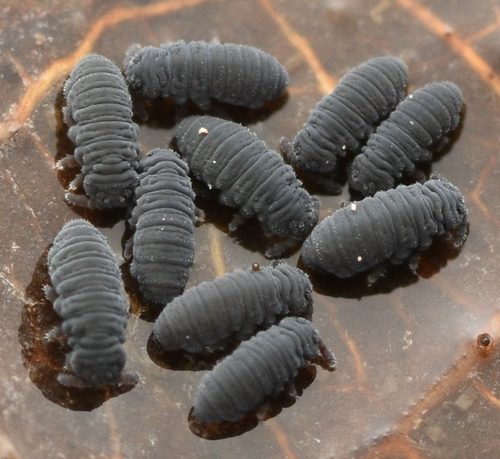
Podura aquatica, commonly known as the water springtail, is a species of springtail. It is one of only four described species in the family Poduridae. This is an abundant species with a Holarctic distribution. Adult water springtails have positive phototaxis, with peak spectral sensitivity in the blue range around 484 nm and the green–yellow range around 570 nm. They also show strong polarotaxis towards horizontally polarized light in the blue range, which is the cue they use to locate suitable water surfaces. As its common name and scientific name suggest, this is an exclusively aquatic species. It spends its entire lifespan living as a scavenger on the surface of all types of still water. This species has a squat body shape, reaching up to 1.5 mm in total length. Individuals are typically bluish grey, though sometimes they are almost black. The furcula of P. aquatica is large and flattened, which lets the animal jump without breaking the surface tension of the water it occupies. This species has a longer tail than springtails in the family Hypogastruridae, which are also common springtails found in standing water. P. aquatica lays its eggs on the water surface. The eggs are hydrophilic, so they immediately sink to the bottom of the water. Embryo development occurs underwater. Once hatched, the young springtail has a hydrophobic cuticle, so it rises back to the water surface to continue its post-embryological development there. Spermatophores are also deposited on the surface of the water by this species.

