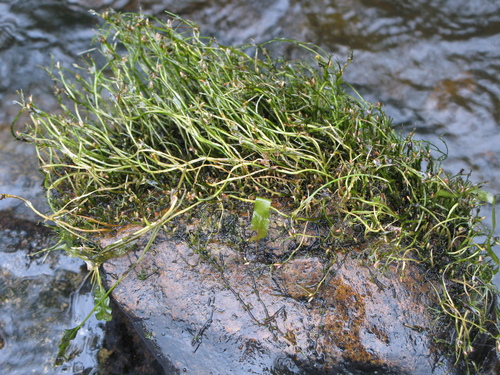
About Podostemum ceratophyllum Michx.
Podostemum ceratophyllum Michx. has green, fleshy, flattened roots that spread in a finger-like pattern over rock surfaces for anchorage. Stems are closely packed, spaced 1 to 9 mm (0.04 to 0.35 in) apart. Its leaves have basal sheaths and boat-shaped leaf bases that extend into stipules, with slender petioles and linear leaf blades. Inflorescences are lateral, and each individual flower is bilaterally symmetric. Each flower has two scale-like tepals shorter than the ovary, plus an additional tepal on top of the andropodium, between the two stamens. The ovary sits on a pedicel and is oriented obliquely, and the fruit is a two-chambered capsule. The overall form of this plant is quite variable, likely shaped by its environment. In one form, leaves reach up to 20 cm (8 in) long, while in another form leaves are stubby and clustered at stem tips. Stems also vary: they may sometimes be hardened and blackish, which contrasts with bright green foliage growth in spring and summer. Leaves may turn red or become senescent in winter. Podostemum ceratophyllum is distributed in eastern North America, with a range extending from Ontario and Quebec south to Ohio, Kentucky, Tennessee, Louisiana, Mississippi, Alabama, and Georgia. It also grows in the Dominican Republic and Honduras. It inhabits fast-flowing rivers and streams on rocky substrates at altitudes up to approximately 800 m (2,600 ft), and acts as a foundation species in mid-sized montane and piedmont rivers. Also called hornleaf riverweed, this species flowers in summer when water levels drop and plants become exposed to air. After pollination, which is likely done by wind or insects, capsules take two to three weeks to mature. Seeds are small and sticky; they can adhere to underwater hard substrates, or be carried to new locations stuck to the legs of birds. This plant grows quickly and vigorously, providing habitat for many aquatic insects and their larvae, as well as Cnidaria, Turbellaria, Mollusca, Annelida, Hydrachnidia, Cladocera, and Copepoda. Small fish feed on these invertebrates, and freshwater snails graze on the plant's foliage. It is also sometimes consumed by turtles, beavers, and white-tailed deer. This plant modifies its environment by altering water flow and encouraging sediment deposition. It also contributes to available detritus, even though its leaves decompose rapidly after being shed. As a foundation species, it removes nutrients from water, accumulates biomass, supplies food to the food chain, and provides habitat. The species is declining across much of its range, though the exact cause is unclear. Potential factors include changes to sedimentation or water quality, changes in water temperature, and overgrowth by epiphytes. Regardless of the cause of decline, reduced populations of hornleaf riverweed are expected to have substantial impacts on local ecosystems.

