About Podolepis gracilis Graham
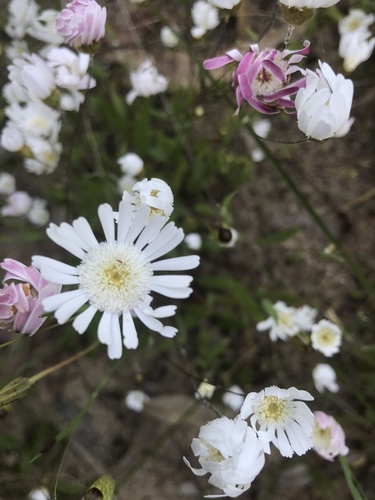
This species, Podolepis gracilis, was originally described by Graham as an annual plant with a descending, tapering root that bears short, branched lateral fibres. Its stem is erect, slender, very slightly compressed, smooth, shining, and slightly flexuose, with suberect branches that match the stem in appearance. Its leaves are 3-nerved, with the central nerve forming a keel on the back, glabrous, shining, somewhat succulent, smooth-edged, sessile, and stem-clasping. Lower leaves measure 3.5 inches long and 0.75 inches broad, with an ovate-oblong shape and a short central point. Upper leaves are ovate-acuminate, and gradually decrease in size closer to the flowers. Its flowers are radiate, and form at terminal or axillary positions. Peduncles are 3 to 4 inches long, filiform, and resemble the stem’s branches; they may even be considered branches themselves, as they bear scattered distant abortive flower buds, each covered by an inconspicuous leaf-like bract. The anthodium is ovate, imbricated, dry, membranous, shining, and greenish, turning pale brown when withered. The anthodium scales are ovate, entire, with a distinct middle rib that occasionally projects at the apex as a small mucro. These scales grow on rough footstalks: in inner scales, the footstalks are as long as the scales themselves, while they are shorter in outer scales. Outer scales are loose, and extend a short distance down onto the peduncle. The receptacle is naked and tubercled. Disk florets are approximately 0.75 inches long, hermaphrodite, rose-coloured (especially at their apices), divaricated, and project outwards between the ray tubes. They are regular and 5-cleft, with spreading segments. The anther-tube is included, bursting at its apex to release white pollen; filaments are nearly as long as the anthers, and inserted into the corolla above the middle of the tube. Ray florets are rose-coloured when young, fading quickly to white, and spread to 1.25 inches across. Their corollulae are ligulate: the tube is 3/8 of an inch long and filiform, while the limb matches the tube in length, is linear-oblong, cordate at the apex, and bi-nerved. Seeds are small, leaden-coloured, lanceolate-oblong, dotted, and slightly tomentose, with a circular, white, slightly excavated umbilicus with prominent edges at their base; many seeds are abortive. The pappus is simple, rough, nearly equal in length, and measures half the length of the ray floret tube, and two-thirds the length of the disk floret tube.