About Podocarpus matudae Lundell
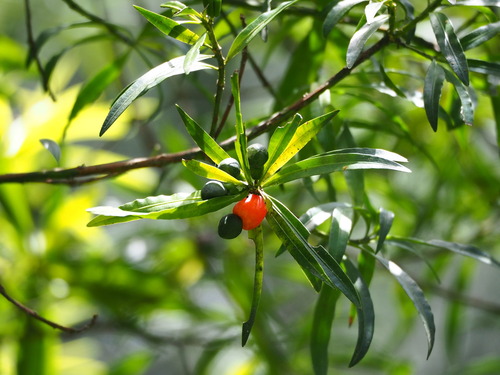
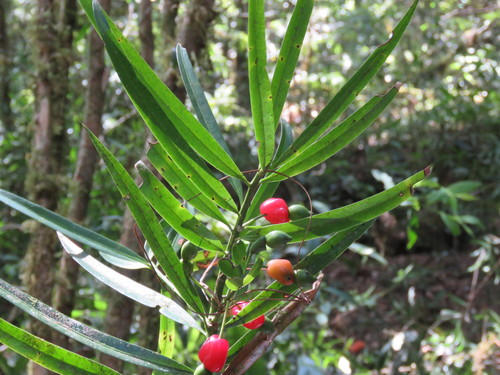
Podocarpus matudae Lundell is a species of conifer that can grow into a large tree, reaching 30 meters or more in height, with a trunk diameter of up to 1.5 meters. Its trunk is typically monopodial and erect. Young trees have thin, smooth, light brown bark, which becomes scaly and grey as the tree ages and weathers. Branches are usually spreading or ascending, and older trees develop a large domed crown. Straight, slender branchlets bear fine grooves left by the leaf bases of fallen foliage. The evergreen leaves are flattened, with a leathery texture, and can be lanceolate, straight, or slightly falcate in shape even on the same branchlet. They have a prominent but narrow midrib. Saplings and young plants produce longer and wider leaves than mature trees: sapling leaves can reach up to 20 cm in length and 17 mm in width, while leaves on mature trees are reduced to 5–14 cm long by 8–13 mm wide. Solitary cylindrical pollen cones grow in the axils of leaf bases. When fully mature, these cones measure 30–34 mm in length and 4–5 mm in width. Seed cones are also solitary, borne on short peduncles that emerge from leaf base axils. They become swollen, red, and succulent before maturing to a brown-purple colour. The seeds are 6–8 mm long, slightly flattened, and oval-shaped, turning dark brown when dried. Podocarpus matudae occurs in mountain regions of eastern, southern, and western Mexico, as well as northern Central America. It inhabits cloud forests located between 800 and 2400 meters above sea level. It grows in moist areas with mild temperatures, average annual rainfall of 1,500 to 3,000 mm, and frequent fog at higher elevations. This species usually grows in small, scattered stands among other forest trees, most commonly oaks (Quercus spp.), alongside species of Liquidambar, Magnolia, Ostrya, and Clethra. It can also be found in ravines and along streams within montane pine-oak forests. In western Mexico's Jalisco and Nayarit, it is typically found growing alongside Clusia salvinii, Pinus herrerae, Pinus gordoniana, Abies guatemalensis, and an unidentified Acer species. Its range covers the east-facing slopes of the Sierra Madre Occidental and Sierra Madre de Oaxaca, from the Mexican state of Tamaulipas to northern Oaxaca, as well as the coastal Sierra de Los Tuxtlas mountains in Veracruz. It also occurs in the Chiapas Highlands of Mexico's Chiapas state, and in the Sierra Madre de Chiapas spanning Chiapas, Guatemala, and El Salvador. These eastern and southern populations are classified as the nominate subspecies Podocarpus matudae subsp. matudae. The population native to the mountains of Jalisco and Nayarit in western Mexico is recognized as a separate subspecies, Podocarpus matudae subsp. jaliscanus.