About Podocarpus henkelii Stapf ex Dallim. & A.B.Jacks.
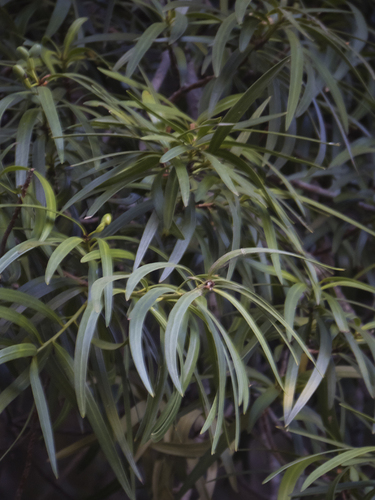
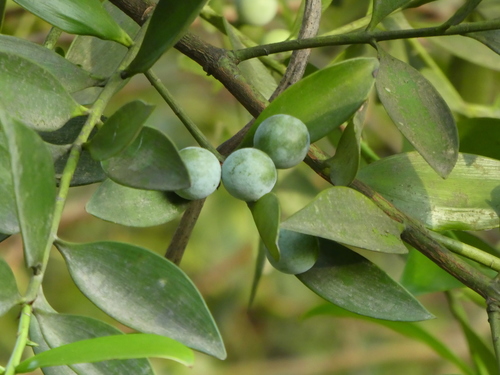
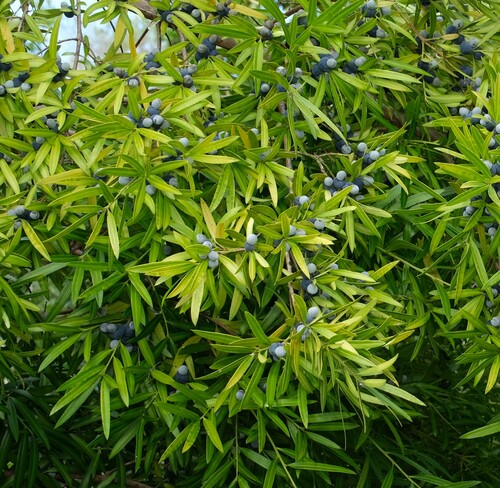
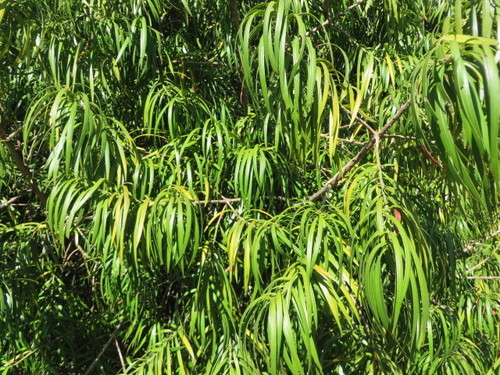
Podocarpus henkelii Stapf ex Dallim. & A.B.Jacks., commonly called Henkel's yellowwood, is an attractive ornamental tree and one of the most recognizable yellowwood species. It can be easily distinguished from its close relatives by its long, slender, drooping leaves. It has a straight, well-formed trunk, naturally grows into a pyramid shape, and eventually reaches a very tall height of around 30 metres (100 feet). Like all yellowwoods, this species is dioecious, meaning individual trees are either male or female. As conifers, they produce cones, though their most prominent structures are fruit-like seeds. These seeds are eaten and distributed by birds. The fleshy coating surrounding the seed contains a germination inhibitor, so being eaten actually aids germination by removing this coating. This tree has some degree of drought tolerance. Henkel's yellowwood is native to the KwaZulu-Natal and Eastern Cape provinces of South Africa, where it grows in the high, moist afro-montane forest of the Drakensberg mountains. It also grows naturally in Afromontane forests in Malawi, Tanzania, and Zimbabwe. It is now widely planted in gardens throughout South Africa, where it is grown as an elegant ornamental tree. It is a protected tree in South Africa. While the real yellowwood tree is officially South Africa's national tree, the group of yellowwoods as a whole, including Henkel's yellowwood, is widely considered to hold this national tree status in practice. This tree was named after Caesar Carl Hans Henkel (1839–1913), an Eastern Cape forester and father of John Spurgeon Henkel, who served as Conservator of Forests for Natal and Zululand. Podocarpus henkelii is increasingly planted in gardens across southern Africa, valued for its neat, attractive form and decorative foliage. It is easy to cultivate, tough once established, and incredibly long-lived. It can also be pruned if needed to alter its shape. Though it is mildly resistant to frost and drought, it is healthiest and grows fastest when planted in deep, moist soils. It can be propagated from seed, which should be planted promptly in a moist, semi-shaded location. The fleshy layer surrounding the seed must be removed because it inhibits germination, and the seed is also vulnerable to fungal infection. Acetone and methanol extracts of Podocarpus henkelii have demonstrated activity against canine distemper virus and lumpy skin disease virus.