About Podisus maculiventris (Say, 1832)
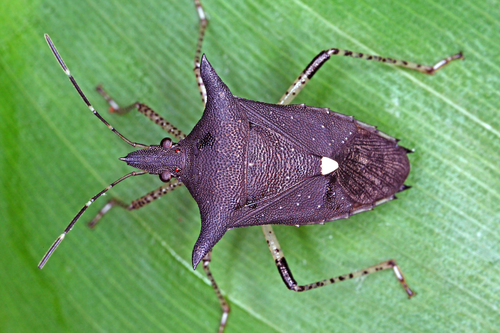
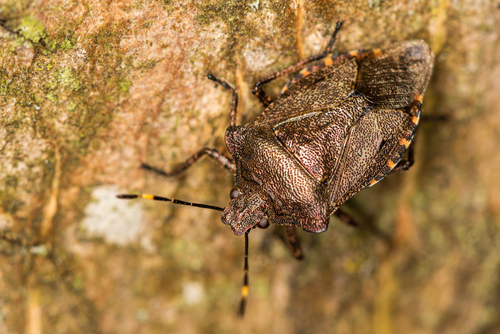
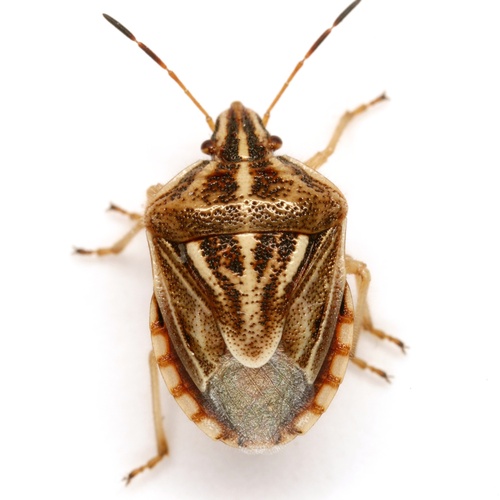
Podisus maculiventris, commonly known as the spined soldier bug, has body coloration that ranges from pale brown to tan. Its body has a shield shape, with prominent, well-defined shoulders called humeri that bear spines, a key diagnostic feature. Another distinguishing mark is a black streak on its wing membrane. Both adults and nymphs use extendable tubular mouthparts to suck fluids from prey; they can extend these mouthparts forward in front of the body, which differs from plant-feeding stink bugs that hold their mouthparts pointing downward during feeding. Both predaceous and plant-feeding stink bugs can fold their mouthparts backward underneath the body.
P. maculiventris is the most common predatory shield bug in North America. Its native range extends north into Canada, and south through Mexico, the Bahamas, and parts of the West Indies. It has been introduced to other countries as part of classical biological control programs. It is widespread across North America, inhabiting a diverse range of environments including woodlands, areas near streams, and various agricultural systems. It is commonly associated with crops; both adults and nymphs forage on these plants, primarily preying on other insects. In warmer regions such as peninsular Florida, this species remains active year-round, while it becomes active only in spring in cooler climates.
Development time from egg to adult varies with temperature and daylight conditions, typically falling between 27 and 38 days. Eggs hatch in approximately five to nine days, with the shortest recorded development times coming from Florida. Adult spined soldier bugs live between one and four months. Young nymphs stay together in groups, becoming more independent as they molt and grow. In warmer regions like Florida, the bugs are active year-round. In cooler northern areas, they typically produce two to three generations per year, and hibernate as adults from October to April. In locations with mild winters, spined soldier bugs can remain active all year. Where winters are cold, adults overwinter in protected spots such as bark crevices, and organic ground litter or other debris. The feeding habits, energy use, and life cycle of P. maculiventris have been well studied, with historical research providing valuable insights into the species' life cycle.