About Podiceps nigricollis C.L.Brehm, 1831
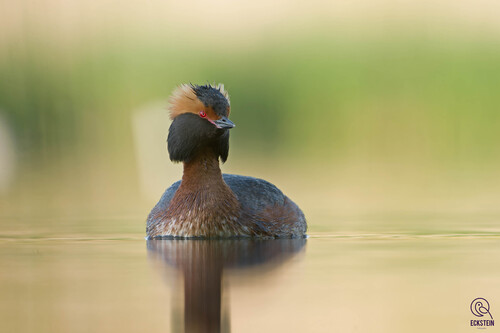
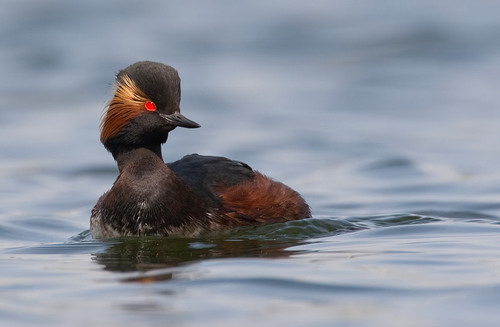
The black-necked grebe (Podiceps nigricollis) generally measures 28 to 34 centimetres (11 to 13 in) in total length. For wingspan, the nominate subspecies P. n. nigricollis has a wingspan of 56–60 centimetres (22–24 in), while P. n. californicus has a wingspan of 52–55 centimetres (20–22 in). Its body weight ranges from 215 to 450 grams (7.6 to 15.9 oz), and males are on average heavier than females. The sexes have similar plumage. In breeding plumage, the nominate subspecies has black to blackish brown colouration on the head, neck, breast, and upper parts. The only exception is an ochre-coloured fan of feathers that extends behind the eye, covering the eye-coverts and sides of the nape. The eye is a vivid bright red, with a narrow paler yellow ring on the inner eye and an orange-yellow to pinkish-red orbital ring. The thin, upturned bill is black, and a blackish line runs from the gape to the eye. Occasionally, the foreneck is mostly tinged brown. The upperwing is blackish to drab brown, with a white patch formed by the secondaries and part of the inner primaries. The flanks range in colour from tawny rufous to maroon-chestnut, and sometimes have blackish flecks. The underwing and abdomen are white; exceptions for the underwing are the dark tertials and mostly pale grey-brown outer primaries. The legs are dark greenish grey. In non-breeding plumage, the nominate has greyish-black upper parts, cap, nape, and hindneck, with the dark colour on the upper portion of the hindneck forming a vertical stripe. The dark cap extends below the eye and spreads diffusely to the ear-coverts. Behind the ear-coverts on the sides of the neck, there are white oval markings. The rest of the neck is grey to brownish-grey with variable amounts of white. The breast is white, and the abdomen is whitish. The flanks are a mix of blackish-grey with white flecks. The bill is significantly more grey in non-breeding plumage than in breeding plumage. Juvenile black-necked grebes are similar to non-breeding adults, but with key differences: dark areas are usually more brownish with less black, the lores are often tinged pale grey, there are whitish marks behind the eye, and the sides of the head and upper neck have a buffy or tawny tinge. Chicks are covered in down, with a blackish-grey head marked with white or pale buff-grey stripes and spots. The throat and foreneck are largely pale, the upper parts are mostly dark grey, and the abdomen is white. Compared to the nominate subspecies, P. n. californicus usually has a longer bill, and has brown-grey inner primaries during the breeding season. P. n. californicus also more often has diffuse pale lores in non-breeding plumage than the nominate subspecies. The African subspecies P. n. gurneyi is the smallest of the three subspecies, and has a greyer head and upper parts. Adult P. n. gurneyi also have a rufous-brown tinge on their lesser wing-coverts. This species breeds in vegetated areas of freshwater lakes across temperate Europe, Asia, eastern and southern Africa, interior southwestern Canada, and the southwest and western United States. After breeding, the species migrates to saline lakes to moult. After moulting, which can take several months, it migrates again to wintering grounds. These wintering grounds include the south-western Palearctic, eastern Africa, eastern Asia, and southern Africa (where it also breeds). In the Americas, it winters as far south as Guatemala, and occasionally further south into Central America. Larger wintering populations in the Americas are mainly restricted to islands in the Gulf of California, the Salton Sea, and Baja California. When not breeding, the species primarily inhabits saline lakes, sheltered inshore seas, and coastal estuaries.