About Podiceps cristatus (Linnaeus, 1758)
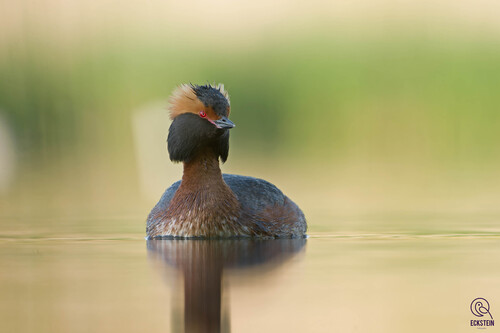
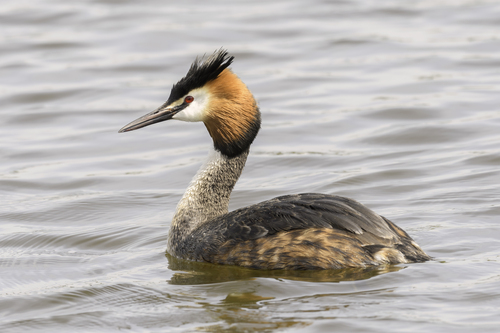
The great crested grebe, with the scientific name Podiceps cristatus (Linnaeus, 1758), is the largest grebe species found in the Old World, though a number of larger grebe species exist in the Americas. Adult great crested grebes measure 46–51 cm (18–20 in) in body length, have a wingspan of 59–73 cm (23–29 in), and weigh 0.9 to 1.5 kg (2.0 to 3.3 lb). This species is an excellent swimmer and diver, and it chases fish prey underwater. In summer, adult great crested grebes can be easily identified by their distinctive head and neck decorations. In winter, their plumage is whiter than that of most other grebe species, with white plumage above the eye and a pink bill. Birds that live year-round in warmer tropical and subtropical regions, especially the subspecies P. c. infuscatus and P. c. australis found in Kenya and parts of Australia, keep their breeding plumage all or almost all year, and develop little to no winter plumage. The great crested grebe’s call is a loud, barking rah-rah-rah. Individuals can also make a clicking kek call, as well as deep growls. Like the chicks of most grebe species, great crested grebe chicks have boldly patterned striped heads with alternating black and white stripes. These chicks are often informally called "humbugs" because their stripes resemble the pattern of humbug sweets. They lose these juvenile markings as they mature during their first winter. Great crested grebes breed in vegetated areas of freshwater lakes. The nominate subspecies P. c. cristatus ranges across Europe and eastward through the Palearctic. It stays year-round in the milder western part of its range, but migrates away from colder regions. It spends the winter on freshwater lakes, reservoirs, or coastal areas. The African subspecies P. c. infuscatus and the Australasian subspecies P. c. australis are mainly non-migratory, staying in their ranges year-round.