About Podiceps auritus (Linnaeus, 1758)
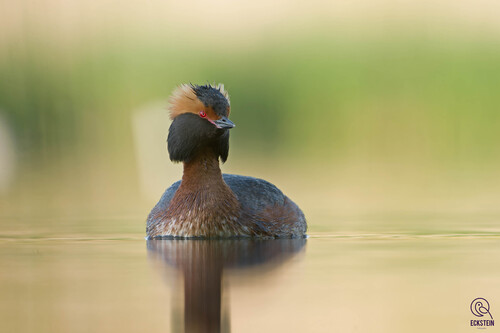
Podiceps auritus (Linnaeus, 1758), commonly called the horned grebe, can be identified by its orange-red and black breeding plumage, black and white non-breeding plumage, and characteristic head "horns". It measures 31–38 cm (12–15 in) in length, has a wingspan of 55–74 cm (22–29 in), and weighs 300–570 g (11–20 oz). It has a moderately long neck, a flat forehead, and a rear crown of black feathers. Its beak is straight and pointed, with a white tip. In breeding plumage, it has bright erectable "horns", black fan-shaped cheek feathers, and an overall red-and-black colour: the neck, flanks, lores, and upper-chest are chestnut brown, while the crown and back are black, and the belly is dull white. Males are slightly larger and brighter than females, but the two sexes are generally indistinguishable. Non-breeding plumage is overall black and white: the neck, chest, and cheeks are white, while the back and crown are dull black-grey, and the border between the crown and cheeks extends in a straight line behind the eyes. Winter plumage does not have the "horns". Juveniles look similar to non-breeding adults, but have slightly duller white colouring, a brown tinge to their back, a less distinct line separating the cheeks and crown, and a paler beak. Chicks are fluffy, with a dull grey back, white belly, and distinct black-and-white striping on the face and neck. Two subspecies are currently accepted. The two accepted subspecies are physically similar in measurements, but differ subtly in plumage: P. a. auritus is darker, with a blacker back and crown, and orange-yellow lateral crown tufts in breeding plumage, while P. a. cornuta is paler, with a greyer back and crown, and straw-yellow tufts. A third subspecies, P. a. arcticus Boie, 1822, was sometimes accepted for populations in coastal Norway, Iceland, and Scotland, but is now treated as a synonym of the nominate subspecies P. a. auritus. In winter plumage, the horned grebe is often confused with the black-necked grebe, which is only slightly smaller and has similar colouring. The two can be differentiated by the black-necked grebe's steeper forehead, more slender slightly uptilted bill, duskier cheeks, and fluffier rump. The species breeds primarily in boreal and subarctic regions with a frost-free period of around 90 days or less, but also breeds in temperate zones including prairies and parklands. Breeding occurs in small to moderately sized (0.5 to 10 ha) shallow freshwater ponds, marshes, and shallow bays on lake edges with beds of emergent vegetation. The species prefers lakes less than 2.5 m deep, with submerged vegetation rather than bare gravel, silt, or mud lakefloors, and marginal vegetation including sedges, rushes, and bulrushes alongside large areas of open water. This habitat provides suitable nest material, anchorage, concealment, and protection for young. The species readily uses lakes surrounded by trees or forest. During migration, it stops along lakes, rivers, and marshes. After migration, it winters in marine environments including waters off estuaries and bays, or near sandy beaches; in some locations such as Norway, large numbers congregate on inland lakes for the winter. Horned grebes dive underwater using their large feet for agile manoeuvrability to feed on aquatic arthropods, fish, and crustaceans. They also catch airborne insects at the water's surface. Underwater they swallow small prey, or capture large prey and re-emerge at the surface to manipulate fish headfirst. They usually feed solitarily or in small groups of up to five individuals. In summer, they prefer aquatic and airborne arthropods, while in winter they favour fish and crustaceans. Like other grebes, the horned grebe has an adaptation for swallowing fish whole: it eats its own feathers from a young age, forming a matted plug in the stomach that functions as a filter to hold fish bones until digestion is complete.