About Podica senegalensis (Vieillot, 1817)
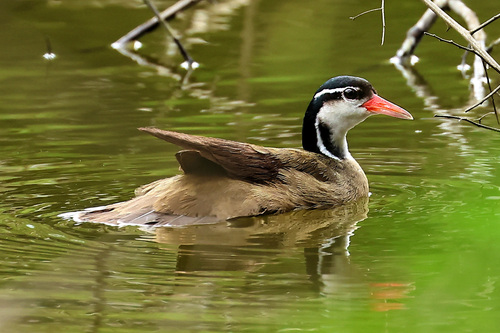
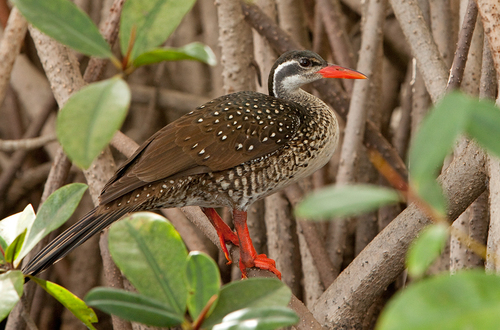
The African finfoot (Podica senegalensis) is an aquatic-specialist bird with a long neck, a distinctive sharp beak, and bright red lobed feet. Its plumage differs between subspecies, and is typically pale on the underparts and darker on the upperparts; males are generally darker than females. It has a superficial resemblance to the torrent duck of South America. This species can be found across a variety of habitats in Africa, always in areas with rivers, streams, or lakes that have ample bank-side cover. Habitats it occupies include forest, wooded savannah, flooded forest, and mangrove swamps. It feeds on aquatic invertebrates, including adult and larval mayflies and dragonflies, as well as crustaceans, snails, fish, and amphibians. The African finfoot is considered highly opportunistic; it captures some prey directly from the water surface, and is skilled moving on land, foraging along banks too. This separates it from grebes, which it resembles but is not related to. African finfoots are most often seen alone or in pairs, and are very secretive. Even experienced ornithologists encounter them very rarely, so sightings are highly sought after by birdwatchers and twitchers. Due to their elusive nature, it remains unclear whether they spend most of their time in the water (where they are almost always observed) or on land. Their breeding season changes with location, and typically coincides with the local rainy season. They build a simple, unstructured nest made of twigs and reeds, placed on a fallen tree above water. The female lays two eggs and incubates them alone. Chicks leave the nest just a few days after hatching.