About Podargus strigoides (Latham, 1801)
Tawny frogmouth (Podargus strigoides) are large, big-headed birds that measure 34 to 53 cm (13 to 21 in) in length. Wild weights have been recorded as high as 680 g (1.50 lb), which is exceptionally high, and individuals in captivity may reach even greater weights. For the nominate race, 55 measured males had an average weight of 354 g (12.5 oz), while 39 measured females had an average weight of 297 g (10.5 oz). The overall weight range for the nominate race is 157 to 555 g (5.5 to 19.6 oz). For the subspecies P. s. brachypterus, 20 unsexed birds had an average weight of 278 g (9.8 oz), with a weight range of 185 to 416 g (6.5 to 14.7 oz). For the subspecies P. s. phalaenoides, the reported weight range is 205 to 364 g (7.2 to 12.8 oz). In terms of average body mass (though not maximum mass), the tawny frogmouth is slightly smaller than its close relative the Papuan frogmouth. On average, wild tawny frogmouths have a maximum life expectancy of 14 years, while captive individuals can live 30 or more years.
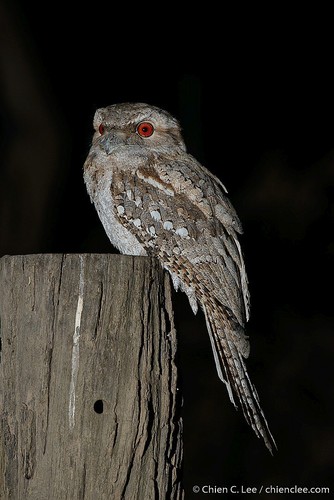
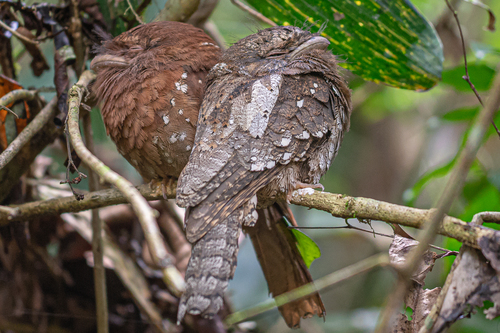
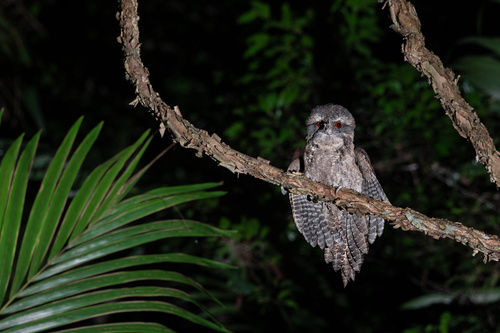
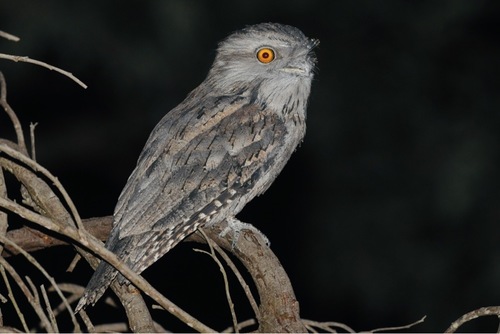
Tawny frogmouths have a stocky, compact build, with rounded wings and short legs. They have wide, heavy bills that range from olive-grey to blackish, hooked at the tip, and marked by distinctive tufts of bristles at the top. Their eyes are large and yellow, a trait they share with owls, but their eyes are not forward-facing like an owl’s eyes. This species has three distinct colour morphs, with the grey morph being the most common in both sexes. Grey morph males have silver-grey upperparts marked with black streaks, and slightly paler underparts marked with white barring and brown to rufous mottling. Grey morph females are often darker with more extensive rufous mottling. A chestnut morph occurs in females of the nominate subspecies P. s. strigoides, and a rufous morph occurs in females of the subspecies P. s. phalaenoides. Aberrant all-white leucistic or albinistic plumage has been documented for this species.
Tawny frogmouths are distributed across most of the Australian mainland, excluding far western Queensland, the central Northern Territory, and most of the Nullarbor Plain. In Tasmania, they are common across the northern and eastern parts of the state. They can inhabit almost any habitat type, including forests, woodlands, scrub, heathland vegetation, and savannahs. They are rarely found in heavy rainforests or treeless deserts. They occur in large numbers in areas with many river gums and casuarinas, and can be found along timbered river courses. Tawny frogmouths are common nocturnal urban wildlife, especially in residential suburbs, and have adapted to human presence. They have been recorded nesting in tree-containing parks and gardens.