About Podarcis siculus (Rafinesque-Schmaltz, 1810)
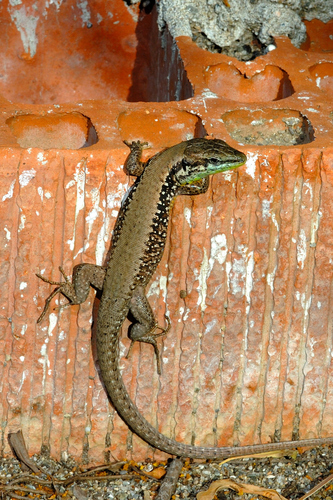
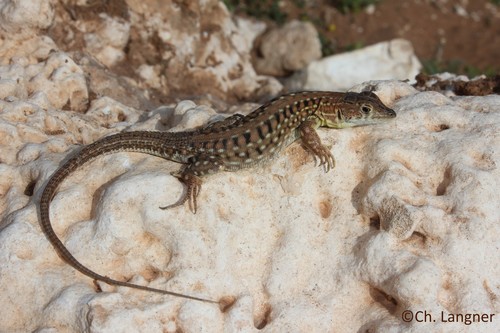
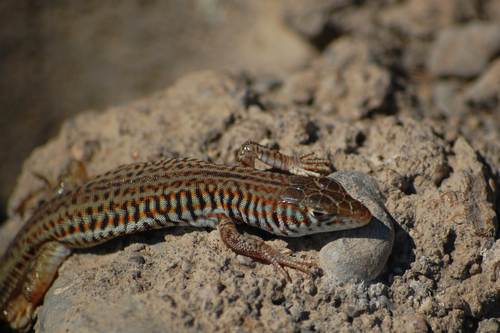
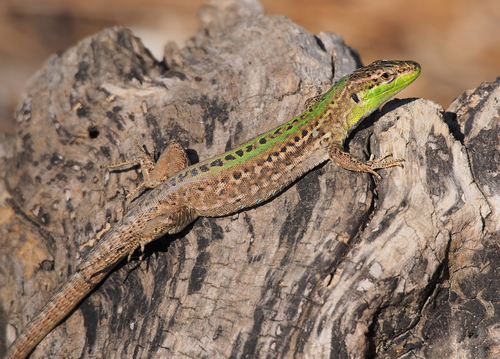
Podarcis siculus, first formally described by Rafinesque-Schmaltz in 1810, has an average snout–vent length of 150–250 mm (5.9–9.8 in). Individuals typically have a green or brown back and a white or green belly. Length and coloration vary widely across the species' many subspecies and populations. For example, some subspecies are melanic, with blue tints on parts of the back and belly; this color form occurs more often in island populations than in continental populations. Head size is sexually dimorphic in this species: males have larger heads and stronger jaws than females. Researchers hypothesize this size difference arises partially from males' differing prey consumption needs, and from male-male aggressive competition. As its common associations suggest, P. siculus is native to Italy, where it is one of the most common lizard species. Its native range also extends to Bosnia and Herzegovina, Croatia, France, Montenegro, Serbia, Slovenia, and Switzerland. It has additionally been introduced to Spain, Turkey, the United States, and Canada. P. siculus is a habitat generalist that survives well in many natural and human-modified environments, including forests, grasslands, shrublands, rocky areas, and farmland. Its ability to thrive in open habitats comes from biological traits including high thermophily, or the ability to grow and survive well at high temperatures. A 2005 study compared seasonal and daily activity patterns of an introduced P. siculus campestris population in New York (United States) to native populations in Rome, Italy. Native P. siculus in Rome are active year-round, while the introduced New York population has a shorter overall activity period, limited to the months of April through October. The lower mean temperatures of the New York habitat are thought to explain this reduced activity window. The New York population is also active for fewer hours each day than the Rome population. Photoperiod (day length) on Long Island, New York (the site of the introduced population) is similar to photoperiod in Rome, which supports the hypothesis that temperature differences are the main cause of differing activity patterns. P. siculus is oviparous (egg-laying). Females can lay 3 to 4 clutches per year, with 4 to 7 eggs per clutch. Clutch egg count varies between populations: for example, populations on small Croatian islands lay fewer eggs, which produce larger hatchlings. The species' reproductive season runs from May through July. Gravidity (egg development) does not create a major physical burden for females, but gravid females bask more frequently than non-gravid females. In male P. siculus, P450 enzyme activity in the brain differs based on the individual's reproductive stage. P450 enzymes localize specifically to regions of the brain that control reproduction and behavior, so this enzyme is thought to be involved in regulating sexual behavior in the species.