About Podarcis muralis (Laurenti, 1768)
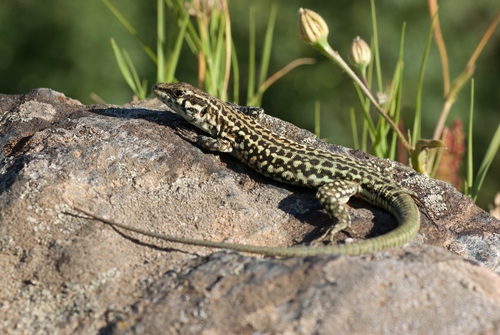
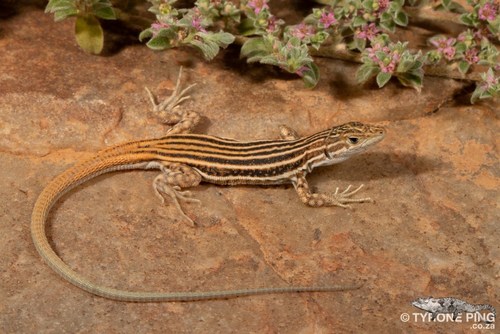
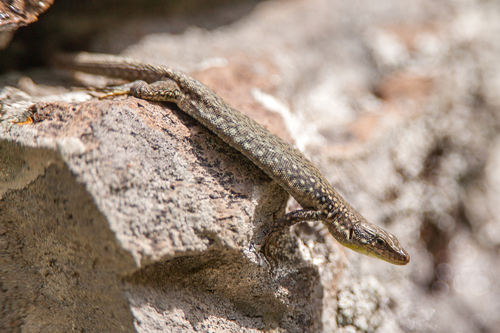
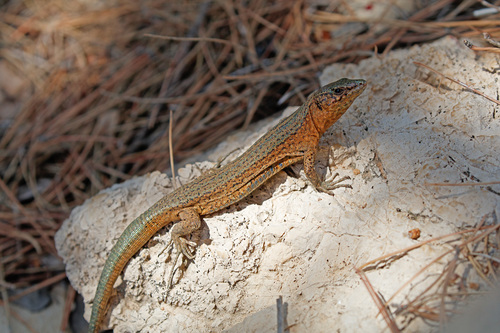
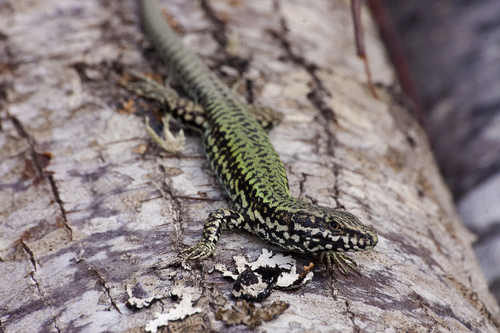
The common wall lizard, scientifically named Podarcis muralis (Laurenti, 1768), is a small, thin lizard with small scales that vary greatly in color and pattern. Its base coloration is typically brownish or greyish, and may sometimes have a green tinge. In some individuals, the row of spots along the back connects to form a continuous line. Other individuals have a reticulated pattern, with dark spots on the sides and scattered white spots that can appear blue in the shoulder area. The tail is colored brown, grey, or rust, and may have light bars along its sides. The belly has six rows of larger rectangular scales, which are usually reddish, pink, or orangish. Common wall lizards may also have dark markings on the throat. This species has six distinct morphological forms, which are identified by the coloration of the throat and underbelly. Three of these are pure morphs, with only solid color on their scales: white, red (orange), or yellow. The other three are mixed-color morphs: white-yellow, white-red, and yellow-red. When laid, common wall lizard eggs average 11 x 7 mm in size and 0.29 g in weight, and absorb water as they develop to reach up to 16 x 10 mm in size and 1 g in weight. The species' natural range covers most of mainland Europe, excluding the far north and extreme south, and extends into Turkey. It has introduced populations in southern Britain, including a well-known population in the seaside town of Ventnor on the Isle of Wight, and also in North America. There is ongoing scientific debate over whether the populations in southern England actually represent the northern edge of the species' native range. It is thought that human activities such as pet releases and trade may have shaped current common wall lizard populations in the Mediterranean region. The common wall lizard prefers rocky environments, including urban areas, where it can move between rock, rubble, debris, and buildings. In the southern portion of its range, it typically lives in humid or semi-humid habitats, while it occupies drier habitats in the northern part of its range.