About Podarcis liolepis (Boulenger, 1905)
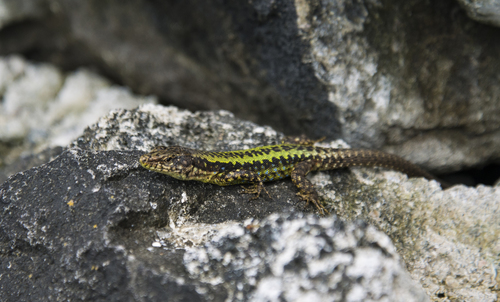
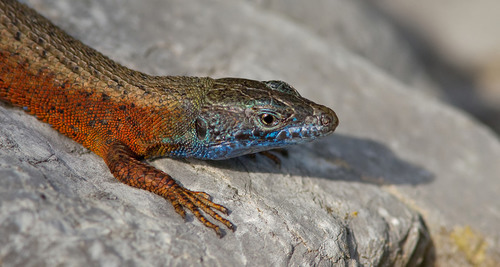
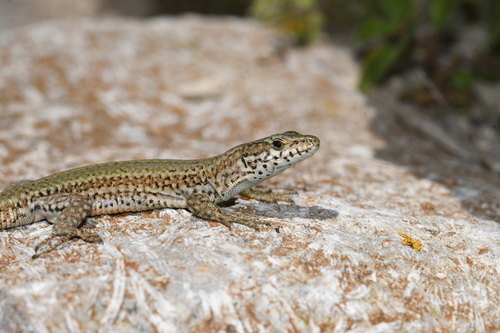
Podarcis liolepis, commonly known as the Columbretes wall lizard or Catalan wall lizard, is very similar to other lizards in the genus Podarcis. This species was formerly classified as a subspecies of the Iberian wall lizard, but has since been elevated to full species status. It is a slender lizard with a long tail, narrow tapered head, long thin toes, and stout legs. Its coloration is variable, though it is generally grey-brown. Very subtle spots and stripes are often visible along its back and flanks, and these markings are more distinct in females. The underside is much lighter, ranging from cream to beige, and sometimes has a reddish tint. Adult individuals reach a total length of 15 to 20 centimeters from snout to tail tip. The body makes up roughly one third of the total length, while the tail accounts for the remaining two thirds. This lizard is found in the northeast of the Iberian Peninsula, including parts of the Pyrenees in southern France. It does not occur at elevations above 3400 meters. The species has a typical lifespan of 4 to 5 years. Individuals reach sexual maturity in their second year. Breeding occurs in spring, after the lizards emerge from winter hibernation. Females lay between 1 and 5 eggs, each measuring approximately 5 by 9 millimeters when laid, in rock cracks or under stones. As the embryos develop, the eggs swell; after 8 weeks of development, when they are ready to hatch, the eggs reach about 8 by 15 millimeters in size. Hatching occurs around early July.