About Poa annua L.
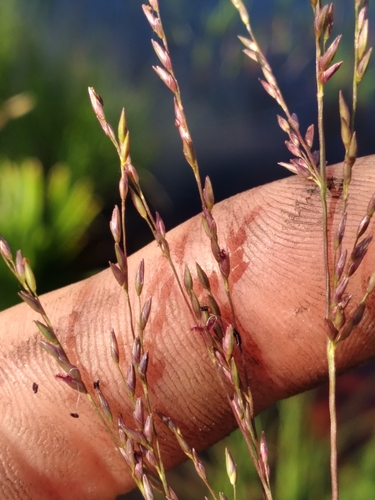
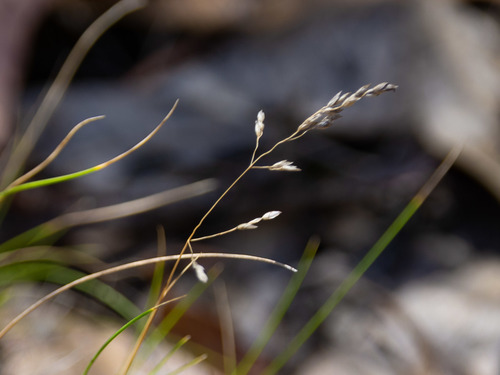
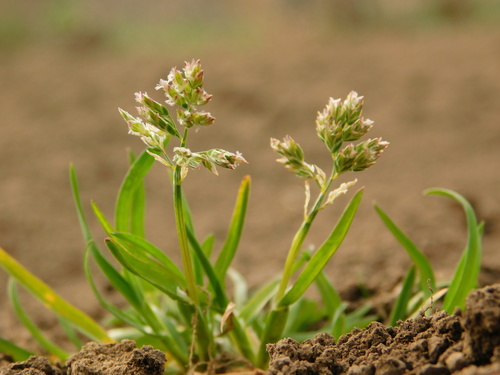
Poa annua L. has a slightly creeping, fibrous rootstock. Its stems grow 15–25 cm (6–10 in) tall, and are slightly flattened because the leaf within is folded rather than rolled. The plant produces an open, triangular panicle that is 5–7.5 cm (2–3 in) long. Its spikelets are stalked and awnless, measuring 1–2 cm (0.4–0.8 in) long when flowering, and are loosely arranged on delicate paired or spreading branches; they are sometimes tinged purple. The vivid green leaves are short with blunt tips, shaped like the prow of a small canoe. They are soft and drooping, with long sheaths that clasp the stem. Leaves are smooth on both upper and lower surfaces, with finely serrated edges, and occasionally have transverse serrations. The ligule is pointed and silvery. This contrasts with the squared ligule of common meadowgrass (Poa pratensis), and the pointed but less silvery ligule of Poa trivialis. Poa annua flowers year-round except during severe winters. Its seeds ripen and are deposited across 8 months of the year. The plant grows rapidly from seed, flowering within 6 weeks, producing seed, and then dying. It is a common cultivation weed, called annual bluegrass in the Americas. It is a common component of lawns, where it is also often treated as a weed, and also grows on waste ground. Many golf putting greens, including those at Oakmont Country Club, are planted with annual bluegrass, though many courses have since converted to creeping bentgrass (Agrostis stolonifera). It has become an invasive species on King George Island in the Antarctic South Shetland Islands, and also on Australia's subantarctic Heard and Macquarie Islands.