About Pluvialis dominica (P.L.S.Müller, 1776)
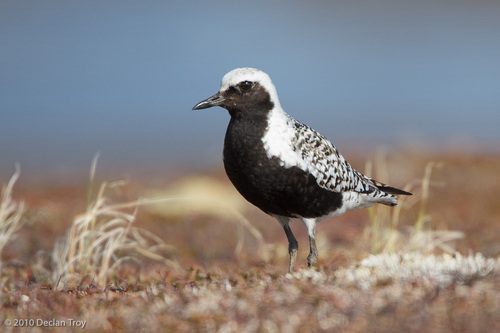
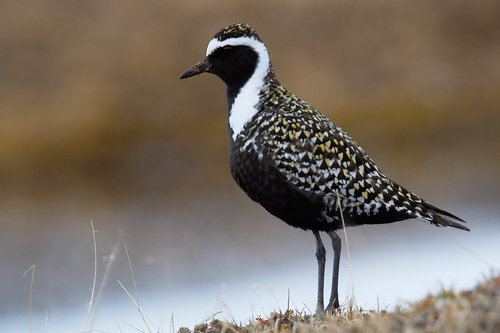
Pluvialis dominica, commonly known as the American golden plover, has the following measured dimensions: body length ranges from 24 to 28 cm (9+1⁄2–11 in), weight ranges from 122 to 194 g (4+5⁄16–6+13⁄16 oz), and wingspan ranges from 65 to 67 cm (25+1⁄2–26+1⁄2 in). Breeding adult American golden plovers have black coloration on the face, neck, breast, and belly, along with a white crown and nape that extends to the sides of the breast. Their back is mottled black and white, marked with pale gold spots. Breeding females have similar patterning, but display less extensive black coloration. When in winter plumage, both sexes have grey-brown upperparts, pale grey-brown underparts, and a distinct whitish eyebrow stripe. This species has a small head and a small bill. The American golden plover is similar to two other golden plover species: the European golden plover and the Pacific golden plover. Compared to the European golden plover (Pluvialis apricaria), the American golden plover is smaller, slimmer, and has relatively longer legs; European golden plovers also have white axillary (armpit) feathers, a trait not shared by the American species. The American golden plover is more similar to the Pacific golden plover (Pluvialis fulva), with which it shares grey axillary feathers; the two were once considered a single species under the name "lesser golden plover". The Pacific golden plover is slimmer than the American golden plover, has a shorter primary projection, longer legs, and typically has a yellower back. In breeding plumage, the American golden plover has solid black coloration on the lower belly and undertail, while Pacific and European golden plovers have at least some to extensive white on the flanks and undertail. First-summer immature American golden plovers often only develop partial summer plumage with incomplete black coloration, making them much easier to confuse with the other two species. Another helpful identifying difference is that post-breeding moult occurs a month or more later in the American golden plover, taking place from September to October on the wintering grounds, while Pacific golden plovers complete their post-breeding moult in August. The American golden plover breeds in Arctic tundra habitat in northern Canada, ranging from Baffin Island west to Yukon and the northernmost part of British Columbia, as well as in Alaska. They nest on the ground in dry open areas. This species is migratory, and winters in southern South America. It follows an elliptical migration route: northbound birds pass through Central America between January and April, and gather in large numbers at sites like Illinois before making their final push north to breeding grounds. In fall, they take a more easterly route, flying mostly over the western Atlantic Ocean and the Caribbean Sea to reach their wintering grounds in Patagonia. This bird has one of the longest known migratory routes, totaling over 40,000 km (25,000 mi). Of this total distance, 3,900 km (2,400 mi) is cross open ocean where the birds cannot stop to feed or drink; they complete this segment of the flight using body fat stores they build up before starting the ocean crossing. It is a regular, though scarce, fall migrant in western Europe, with typically 20 to 25 sightings recorded annually in Great Britain; spring sightings are much rarer. A comparison of migration dates and migratory patterns leads to the conclusion that Eskimo curlews and American golden plovers were the most likely shore birds that drew Christopher Columbus's attention to the nearby Americas in early October 1492, after 65 days at sea out of sight of land.