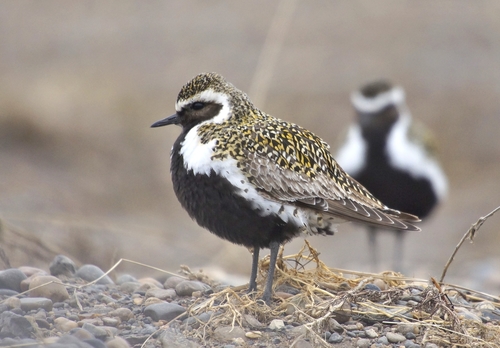
About Pluvialis apricaria (Linnaeus, 1758)
This species, known as the European golden plover, has a fairly thickset build, with wings that are only slightly longer than its tail. Its most prominent distinguishing feature is a white S-shaped band that stretches from its forehead to its flanks.
For breeding, the European golden plover typically occupies Arctic tundra and other moorland areas. Its breeding range extends west to Iceland, where it is locally called Heiðlóa, and east to central Siberia. The southernmost breeding populations occur in Wales and Belarus; a small breeding population that was previously found on Dartmoor in southwest England became extinct around 2010.
During winter, the species migrates southwest to milder regions of Europe, northwest Africa, and southwest Asia. Its winter range reaches from Ireland east to Denmark, and south through the Mediterranean region as far as Algeria, northern Egypt, and the Caspian Sea coast of Iran. European golden plovers usually gather in large flocks across open habitats including agricultural plains, ploughed land, and short meadows. These habitats range from lowland plains to subarctic plateaus, and the species is generally found on flat terrain with moderate vegetation located near wetlands. Vagrants of this species have been recorded as far west as the east coast of Canada (Newfoundland and Nova Scotia), as far south as Gambia, and as far east as Pakistan and northern India.
The call of the European golden plover is a monosyllabic, slightly descending, melancholic "tuu". Its flight is rapid and powerful, produced with steady, regular wingbeats. In the United Kingdom, golden plover chicks depend on craneflies as a food source, while march flies are a more important food source for chicks in Sweden.