About Pluteus salicinus (Pers.) P.Kumm.
Scientific name: Pluteus salicinus (Pers.) P.Kumm.
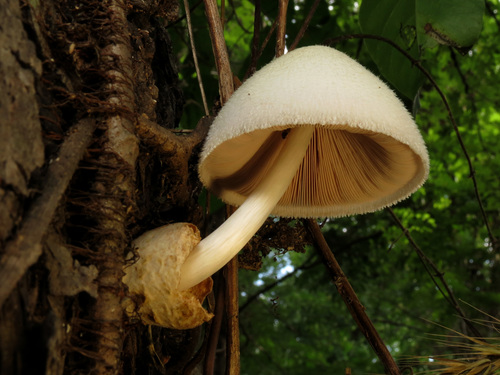
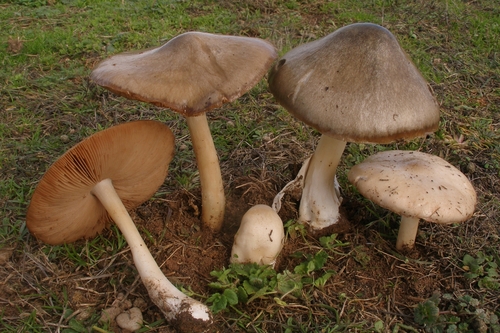
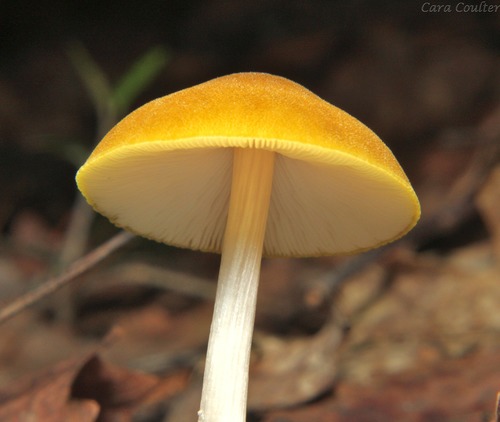
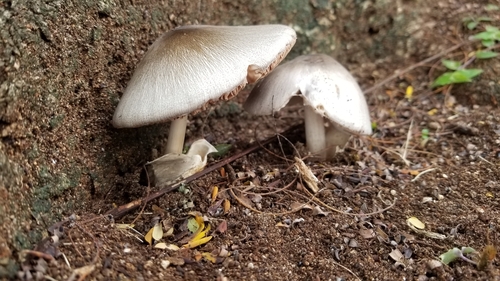
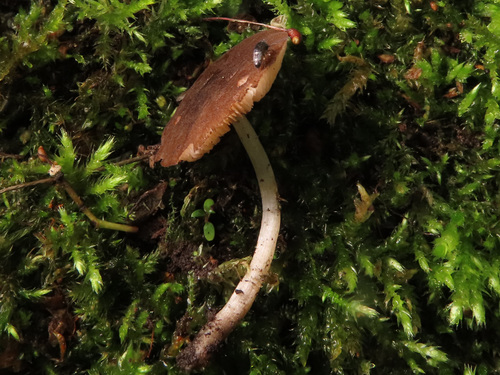
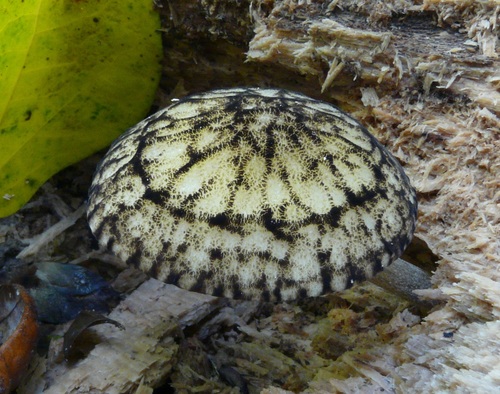
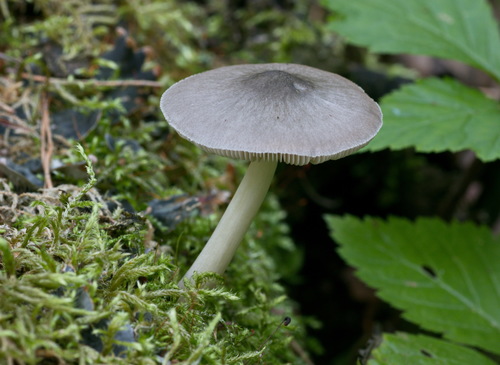
Cap: 2 to 5 centimeters in diameter, rarely reaching up to 8 centimeters. It starts convex and matures to broadly convex or flat. Its color ranges from silver-gray to brownish-gray, and often develops a blue or greenish tint as it ages. The cap surface is smooth, with tiny scales near the center, darker color at the margin, and is slightly translucent-striate when moist. The cap margin has no lining. The cap flesh is white with a grayish tinge, with thin to moderate thickness. The cap skin is fibrous.
Gills: They are crowded, broad, free from the stipe, and ventricose. They start white and turn pink-flesh colored as they mature. Gill edges become discolored or bruise grayish.
Stipe: 3 to 5 centimeters long, rarely reaching up to 10 centimeters, and 0.2 to 0.6 centimeters thick. It is roughly equal in width along its length or slightly swollen at the base. The stipe flesh is white with grayish-green to bluish-green tones, most prominent near the base. No ring is present. The stipe is firm, and is either full or stuffed internally.
Taste: Unpleasant, indefinite, or somewhat raphanoid (similar to radish). Odor: Unpleasant, indefinite, or somewhat raphanoid.
Spores: Pink, smooth, measuring 7–8.5 × 5–6 μm. Spore print is pink-flesh colored to brown-pink.
Microscopic features: Pleurocystidia are fusiform with slightly thickened walls, measuring 50–70 × 11–18 μm, and have 3–5 horn-like projections.
Habitat and distribution: This mushroom has a wide distribution across western Europe and Siberia. It grows on wood from hardwood species including Alnus, Eucalyptus, Fagus, Populus and Quercus, and always grows on wood. It fruits from summer to fall, growing either solitary or gregariously on dead hardwood wood, in damp flood-plain forests.