About Pluteus americanus (P.Banerjee & Sundb.) Justo, E.F.Malysheva & Minnis
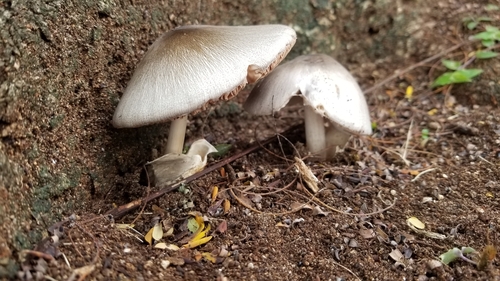
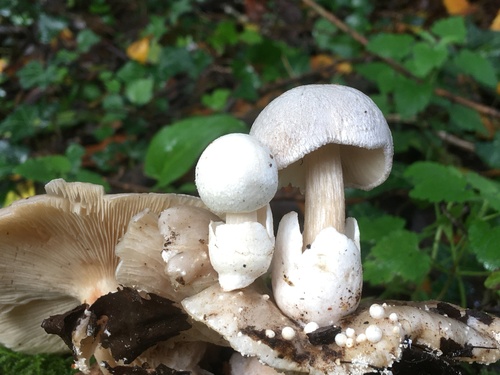
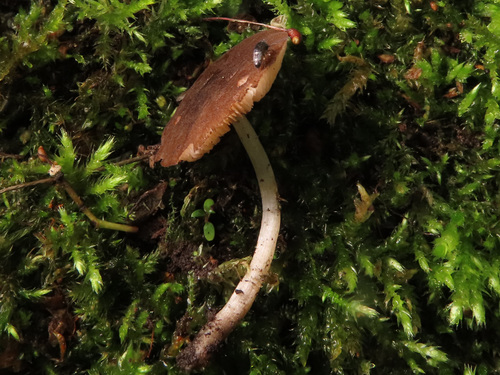
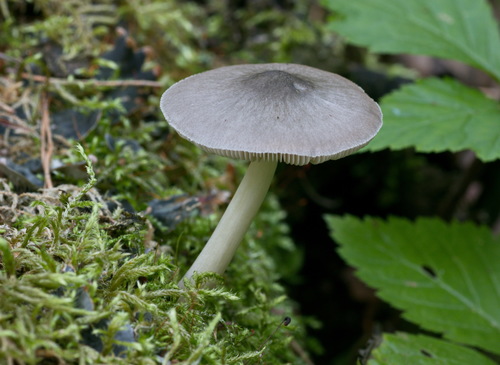
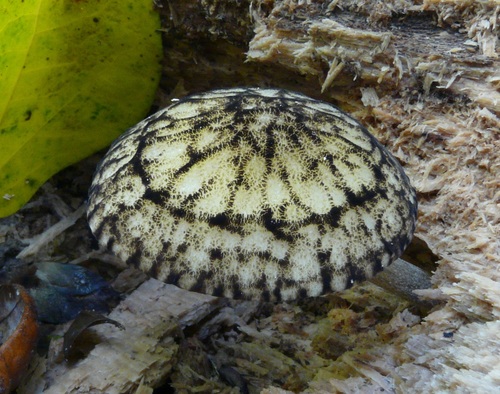
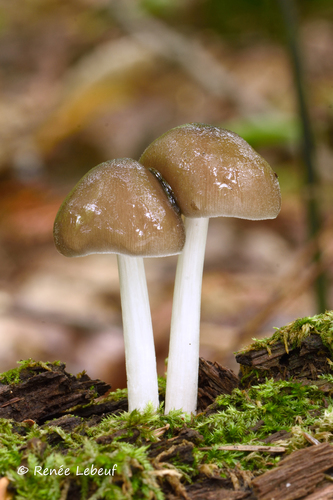
Pluteus americanus (P.Banerjee & Sundb.) Justo, E.F.Malysheva & Minnis has a cap that ranges 1–6 cm in diameter. When young, the cap is campanulate to hemispherical, and expands to convex when mature. It often has a low, broad umbo, with a darker squamulose texture at the cap center. The cap margin can be radially fibrillose. Cap color is brown to grey, usually darker towards the center, and occasionally stains blue. The cap surface is dry to somewhat viscid when moist, and lightens in color as it dries.
The gills are crowded, broad, and free from the stipe. They are white when young, turning pink at maturity, and sometimes bruise blue.
The stipe measures 1.5–6.5 cm long and 0.3–0.6 cm thick. It is more or less equal in width along its length, or slightly swollen at the base. It is white with grayish-green to bluish-green tones, which are especially prominent near the base or in areas that have been damaged. No ring is present on the stipe.
The taste of this species resembles Pelargonium leaves, and is occasionally mild. The odor is strong and similar to Pelargonium leaves, and is also occasionally mild.
Spores are pink, smooth, and ellipsoid, measuring 6.5–9.5 (-11) x 4.5–7 (-7.5) μm. The spore print is pink-flesh colored to brown-pink. For microscopic features: pleurocystidia are common, metuloid, and shaped fusiform, narrowly fusiform or narrowly utriform with slightly thickened walls, measuring 50–93 x 12–24 (-28) μm, and have 2–4 horn-like projections. Cheilocystidia measure 34–65 (-70) x 12–22 μm, and are clavate, narrowly clavate or spheropedunculate, hyaline or brown, thin-walled, forming a sterile band. The pileipellis is a cutis with cylindrical terminal elements that occasionally narrow at the apex, and are hyaline or brown. Clamp connections are common.
This species grows solitary or gregariously on the wood of Fraxinus, Acer saccharum, Betula papyrifera and Populus, from July through October. It is widely distributed across Eastern North America, and may also occur in western North America. It has also been found in the Russian Far East (Primorsky Territory).