About Plutella xylostella (Linnaeus, 1767)
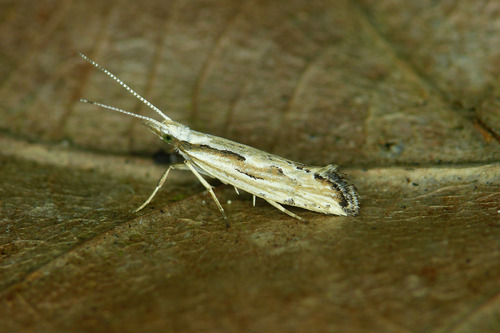
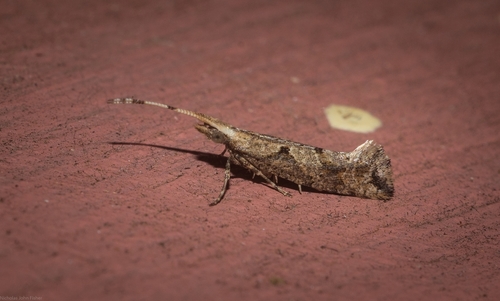
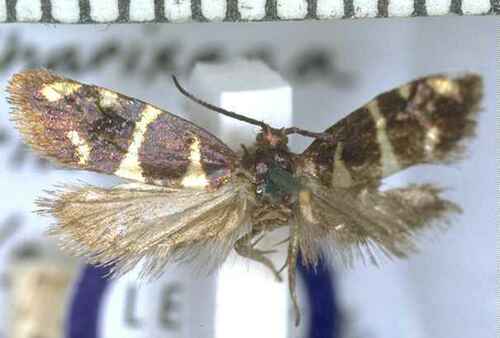
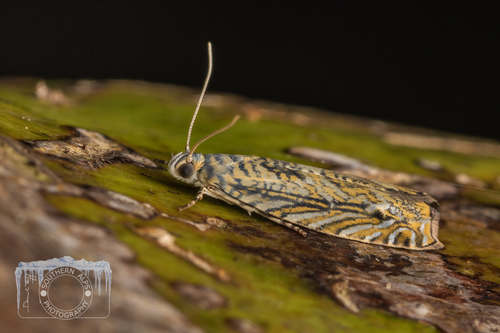
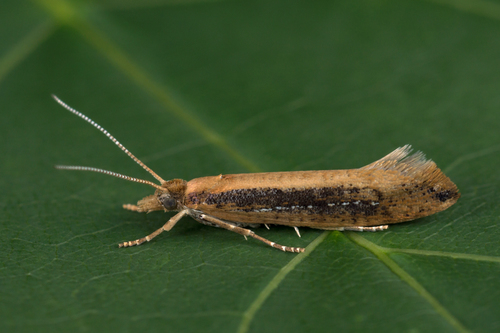
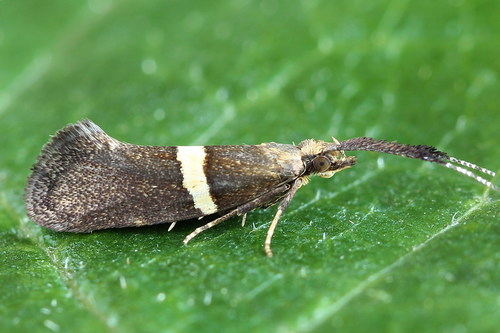
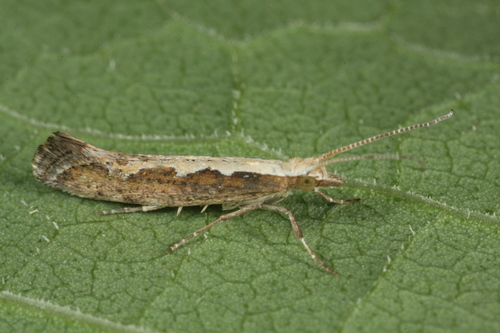
This is a description of Plutella xylostella (Linnaeus, 1767), commonly known as the diamondback moth. This small moth has a gray and brown coloration. It can potentially be identified by a cream-colored band that may form a diamond shape on its back. It has a wingspan of about 15 mm and a body length of 6 mm. Its forewings are narrow, brownish gray, and lighter along the anterior margin, with fine dark speckles. A creamy-colored wavy-edged stripe runs along the posterior margin; this stripe is sometimes constricted to form one or more light-colored diamond shapes, which gives the moth its common name. The hindwings are narrow, pointed toward the apex, light gray, and have a wide fringe. When viewed from the side, the tips of the wings can be seen to turn slightly upward. This species has pronounced antennae. Adult Plutella xylostella are visually identical to adult Plutella antiphona, a moth species endemic to New Zealand. The diamondback moth has a global distribution, and is found in Europe, Asia, Africa, the Americas, Australia, New Zealand, and the Hawaiian Islands. Some experts state it is the most widely distributed species among all Lepidoptera, but even with widespread interest in limiting the damage this moth causes, the actual available data on its distribution is inadequate. It probably originated in Europe, South Africa, or the Mediterranean region, though its exact migration path is not known. In North America, it was first observed in Illinois in 1854, and by 1883 it had been found in Florida and the Rocky Mountains. Although diamondback moths cannot overwinter effectively in cold climates, it was found in British Columbia by 1905, and is now present in several Canadian regions.