About Plodia interpunctella (Hübner, 1813)
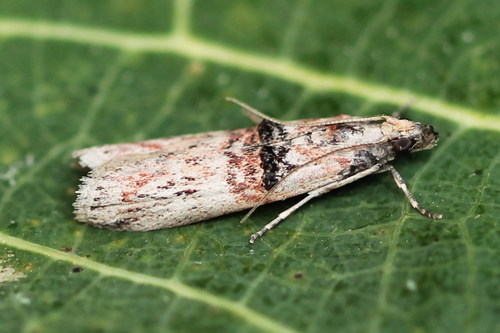
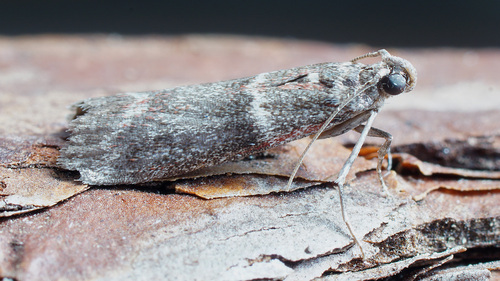
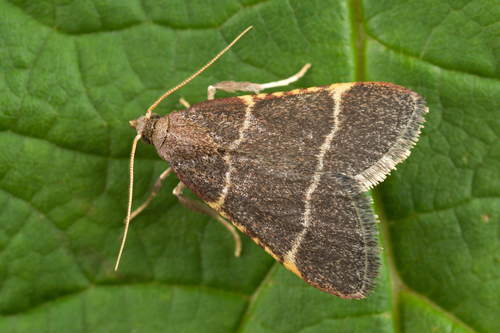
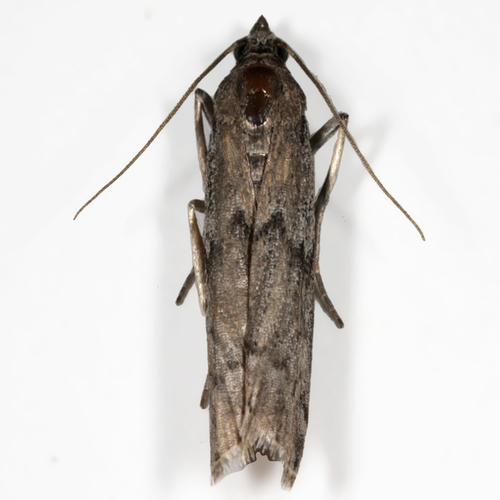
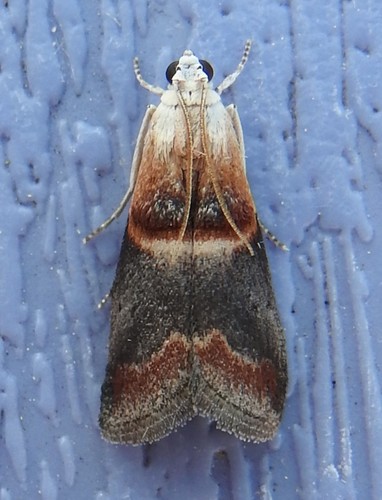
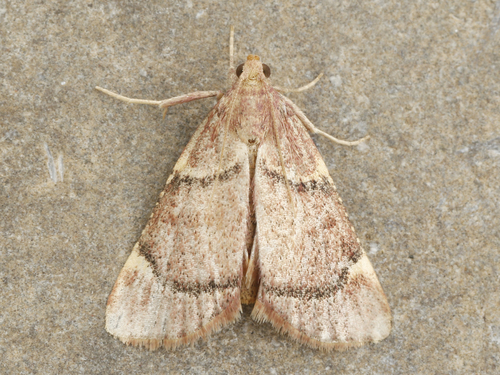
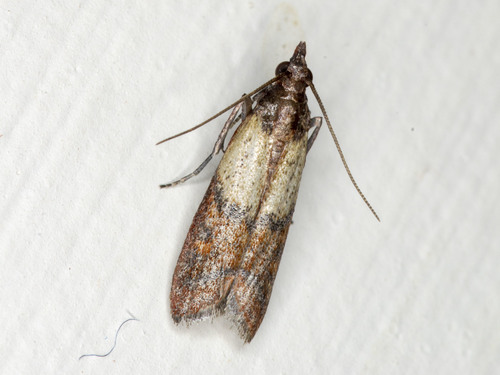
Adult Plodia interpunctella, the Indian-meal moth, are 8–10 millimetres (5⁄16–13⁄32 in) long, with a wingspan of 16–20 millimetres (5⁄8–13⁄16 in). The distal two-thirds of their forewings are typically reddish brown with a copper luster, and may also be bronze or dark gray. The more proximal sections of the forewings are yellow-gray or white-gray, with a dark band located at the border between the proximal and distal regions. The hindwings are generally uniformly gray. The eggs of this moth are white, ovate, and very small, and are difficult to see with the naked eye. Newly hatched larvae are also hard to see with the naked eye; they are mostly off-white with brown heads, and go through five to seven larval instars during development. Mature larvae measure about 12–14 millimetres (15⁄32–9⁄16 in) long. Larvae have three sets of legs near the head, and five sets of prolegs that protrude from the abdomen. These legs allow larvae to move over long distances to find sites for pupation. Plodia interpunctella is found in tropical habitats on every continent except Antarctica. Within the United States, the moth is most common in Florida, where it grows well in the state's tropical habitat. The species can live in a wide range of conditions, which makes it a persistent pest. It is often found in food storage facilities around the world, especially in grain bins or grain storage buildings. Indian-meal moths feed on plants, grains, and other human food products. The most common competition experienced by Indian-meal moths stems from a lack of food. This competition can alter the emergence timing of males and females, which reduces the chance that early-emerging males will find females to mate with, and may encourage emigration. This is classed as a form of male–male competition, because males that emerge at an appropriate time are more likely to be reproductively successful with nearby females. Males also compete for pupation sites. If larvae do not find pupation sites within the food layer, they may travel long distances to find a suitable site. Competition for pupation sites affects males more than females, but it indirectly impacts females as well by leading to a delayed population of available males to mate with.