About Ploceus sakalava Hartlaub, 1861
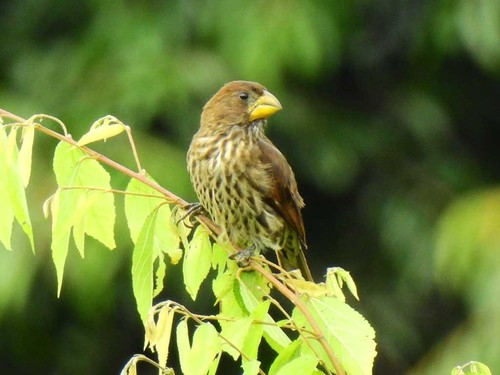
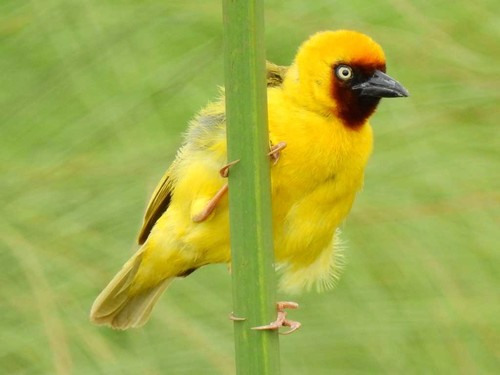
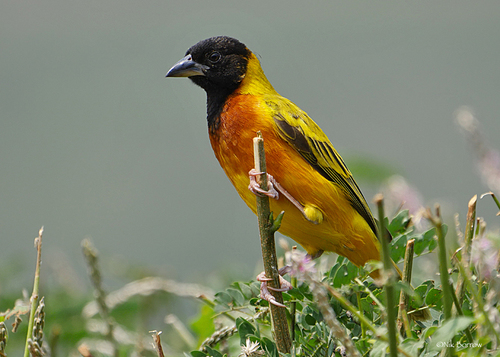
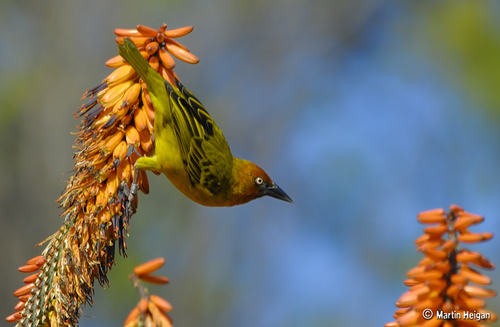
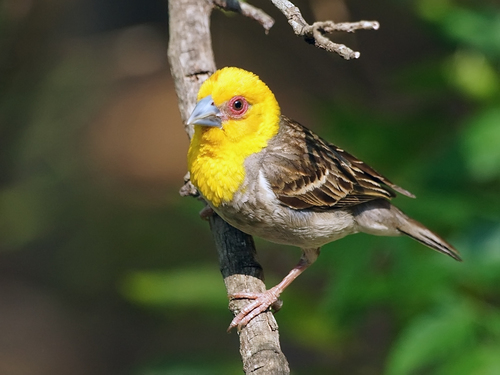
This species, scientifically named Ploceus sakalava Hartlaub, 1861, has distinct plumage traits for different sexes and life stages. Breeding adult males have a yellow head and upper breast, pale grey belly, light brown wings with white wing-tips, distinctive red eye-rings, and a silver bill that extends into a V-shape onto the forehead. Non-breeding males have a dark brown head, pale grey breast, and white flanking. Females resemble house sparrows, with a pale almost white breast, a duller slightly pink bill, a red eye-ring, and sometimes small flashes of red around the eye. This species occurs in small flocks. Its natural habitats are dry lowland forests and scrubland in northern, western, and southern Madagascar, which are classified as subtropical or tropical dry forests and subtropical or tropical dry shrubland. Like other true weaver birds, it weaves a roofed nest from strips of grass leaf, but it also uses strips of palm frond or thatching and weaving materials collected from villages. The top of the nest is woven directly around a branch, or attached via a short woven stalk. The nest is retort-shaped, with a pear-shaped nesting chamber and a long entrance tunnel hanging from the top. The nest fabric is thin but dense; the tunnel fabric is less dense, may be slightly transparent, and may be somewhat wider at both ends.