About Ploceus nelicourvi (Scopoli, 1786)
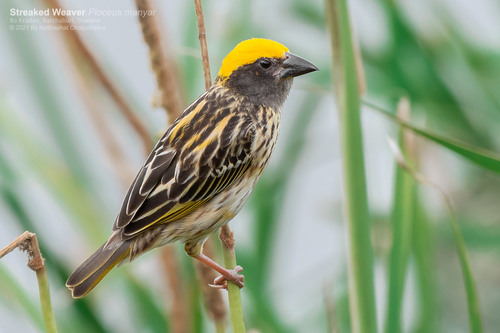
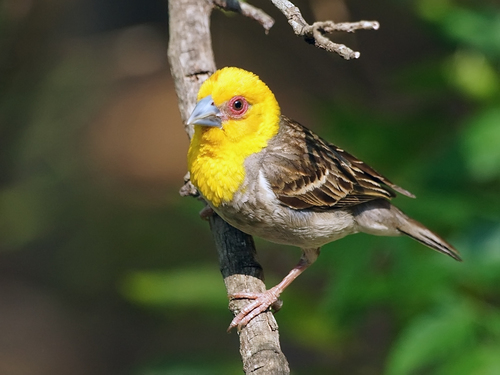
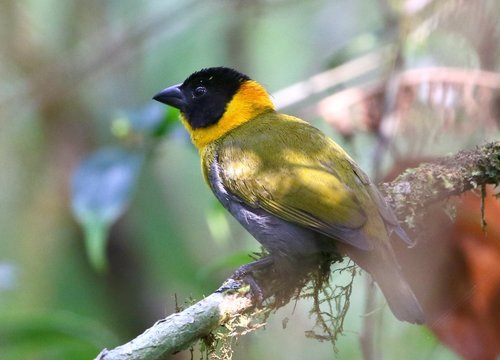
The nelicourvi weaver, Ploceus nelicourvi, is a slender, sparrow-like bird measuring 15 cm (5.9 in) in length and weighing 20–28 g (0.71–0.99 oz). In breeding plumage, the male has a black beak, reddish-brown eyes, and blackish to brownish-grey legs. Its entire head is black, including the cheeks, area around the ears, forehead, crown, and nape. This black head is surrounded by a broad yellow collar that covers the chin, breast, and all sides of the neck. The yellow collar is itself bordered by a vaguely defined olive-green band. The lower chest and belly are bluish-grey, while the lower flanks are grey with a greenish tint. The flight feathers of the wing are blackish: feathers closer to the wing tip have narrow greenish-yellow edges, and feathers closer to the base have broad olive-green edges. The alula and primary coverts are blackish, and all other wing coverts are bright olive green. The underside of the wing is covered in light grey feathers with a yellowish tinge. The shoulders and upper tail base are also bright olive-green, the under tail base is chestnut-colored, and the tail flight feathers are blackish with wide olive-green edges. Non-breeding male plumage differs in that the black head becomes olive green mottled with dark grey, and a narrow yellow brow is present. In breeding plumage, the female has a yellow front of the head that gradually changes to olive green at the back of the head, with a broad yellow rear brow. The area between the eye and bill is dark greenish grey, and the area around the ear is green. Like the male, the female’s head is surrounded by a broad yellow collar that includes the chin. The rest of the breeding female’s plumage is identical to the breeding male’s. The nelicourvi weaver can be told apart from the related sakalava weaver, which has streaked plumage. The somewhat related forest fody and Madagascar fody mostly have streaked upperparts and bright scarlet as their most visible color. This species is endemic to Madagascar. It occurs along the full length of the rainforest belt that stretches from the Tsanatanana mountains in the north to the south-east of the island. It is also found in the littoral forests of the eastern coast, reaching almost but not quite Tôlanaro (formerly Fort-Dauphin) in the south-east. It can be found from sea level up to around 1,500 m (4,900 ft) altitude, and occurs as high as 2,100 m (6,900 ft) in Marojejy National Park. An isolated population lives far to the north at Amber Mountain National Park. It mostly inhabits moist lowland and mountain forests, but also occurs in sclerophyllous mountain forests, bushland, and thickets. Nelicourvi weavers forage from the forest floor up to the canopy, and particularly favor the forest middle story. They usually move alone, in pairs, or in groups of three, and may sometimes mix with long-billed bernierias. They do not form large flocks. The nelicourvi weaver is an agile, active species that is generally quite vocal. It searches for insects on leaves and branches while hanging from vines and twigs. It looks for prey in rolled leaves (such as those of wild ginger Aframomum) and along leaf litter, probes crevices, and splits open dead stems. It also dismantles flowers to access nectar. Its diet mostly consists of arthropods including beetles, bugs, butterflies, caterpillars, dragonflies, flies, grasshoppers, leafhoppers, stick insects, millipedes, and spiders. It sometimes consumes small vertebrates such as lizards and chameleons, and also feeds on nectar, fruit, and likely seeds. The species appears to be monogamous, forming long-term pair bonds. Nests are built spaced apart from other nests of the species; occasionally two nests may be within a few meters of each other, but the species does not form breeding colonies. During the breeding season, males display while perched on a horizontal branch, holding their wings fluttering low and calling loudly. Mating begins on the sixth day of nest construction. The male chases other birds away from the nest, likely to prevent other pairs or cuckoos from laying eggs in it. Egg-laying usually occurs between October and March, which corresponds to the late dry season and rainy season. Nest building can start as early as August and does not always indicate an upcoming breeding attempt. Nests are conspicuous. They are usually placed in the open away from surrounding vegetation, attached to a typically defoliated limb, bamboo stem, or vine, hanging 2–8 m (6.6–26.2 ft) above a clearing or stream. The nest is attached to its support via a 10–30 cm (0.3–1 ft) long rope-like section. It is shaped like a retort, with an oval nesting chamber that is 12–22 cm (4.7–8.7 in) high and 10–18 cm (3.9–7.1 in) in diameter. A vertical entrance tube is attached high on one side of the chamber, and is at least as long as the nesting chamber is tall. The nest is a firm structure built from strips of grass, sedge, and palm fronds, with a thin lining of palm fibers at the bottom of the nesting chamber. The male builds the outer nest structure, while the female brings the lining material. Nest construction takes approximately twelve days total. A clutch holds 1 to 4 eggs, most often 3. The eggs are oval, smooth, somewhat shiny, and vary in shade from pale to blue-green, measuring about 20.5 mm (0.8 in) long and 15 mm (0.6 in) in diameter. Only the female incubates the eggs, which hatch after fifteen days. Males do not have brood patches. Both parents feed the chicks and remove fecal sacs from the nest.