About Ploceus hypoxanthus (Sparrman, 1788)
This species, the Asian golden weaver, has the scientific name Ploceus hypoxanthus (Sparrman, 1788).
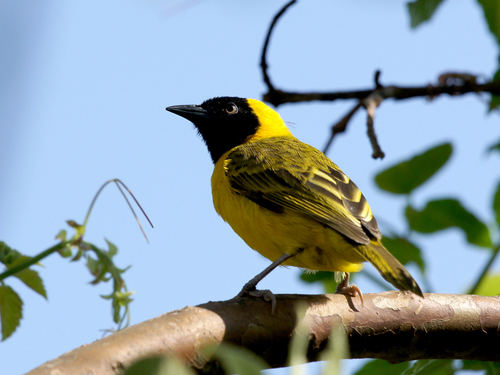
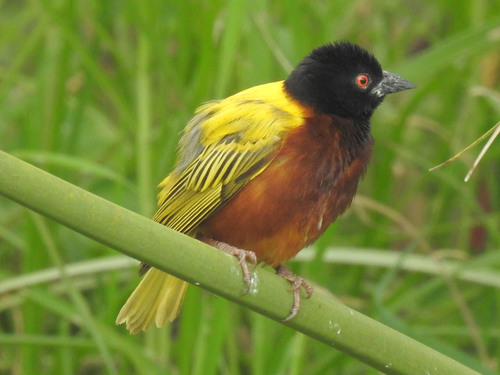
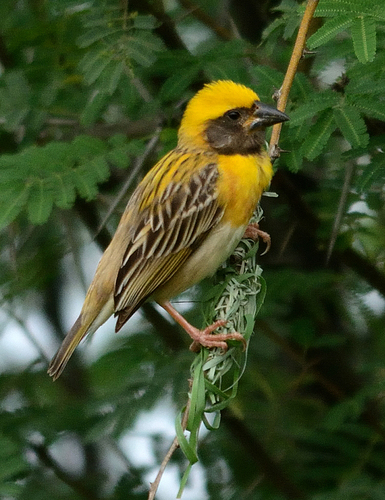
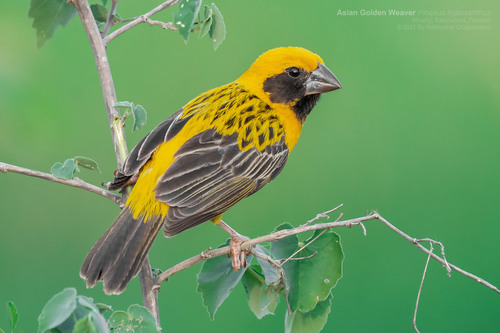
Description: Breeding males are overall bright yellow with a diagnostic black mask that distinguishes them in Asia. Females, non-breeding males, and juveniles are dull-colored, and hard to tell apart from Baya Weavers—only their thicker bill sets them apart. Asian golden weavers are medium-sized birds, with yellow and black upperparts and yellow underparts. They have a black face, yellow crown, and a strong black bill, with an average length of 22 centimeters.
Distribution: There are two distinct subspecies of the Asian golden weaver. P. h. hypoxanthus occurs in Indonesia, on eastern Sumatra and western Java. P. h. hymenaicus occurs in Myanmar (including Tenasserim), Thailand, Laos, Cambodia and southern Vietnam. This subspecies differs by having mantle feathers fringed with more greenish yellow, and upper breast more strongly suffused with raw sienna. The Asian Golden Weaver was formerly more widespread across Java and Sumatra, but is now localized and rare. Its population continues to decline across its range as wetlands are converted to agricultural land. The species also faces direct persecution and capture for the bird trade, and people often rob and destroy its colonies. The oldest recorded individual of this species was 11 years old.
Behavior and ecology: Asian golden weavers are primarily presumed to be resident, staying in their preferred habitats year-round. They most commonly live in lowland areas close to water, including marshes, rice paddies, flooded grasslands, and swamps. This weaver feeds mainly on seeds; during the breeding season, insects make up only 7% of its diet. While it is not globally threatened, the Asian golden weaver is classified as Near Threatened, primarily due to ongoing moderate population decline.