About Ploceus cucullatus (Statius Muller, 1776)
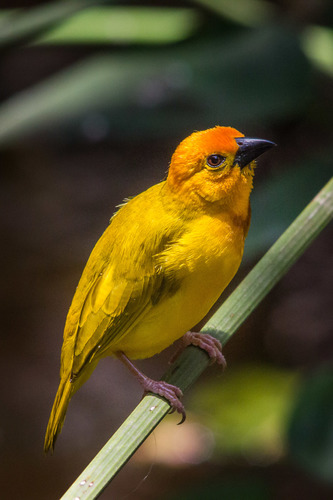
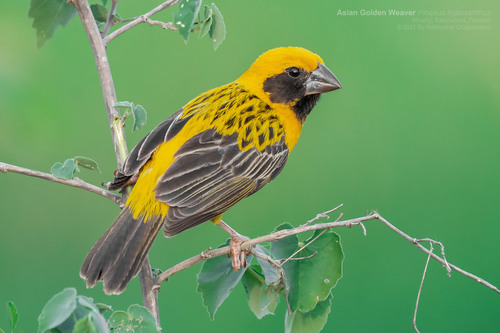
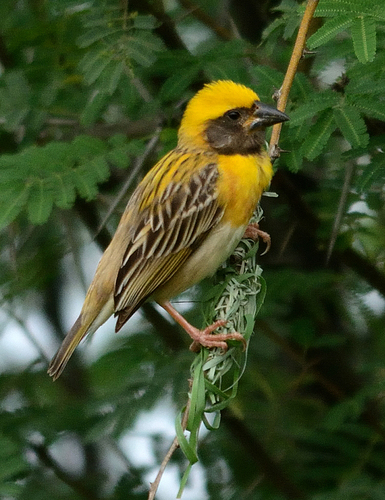
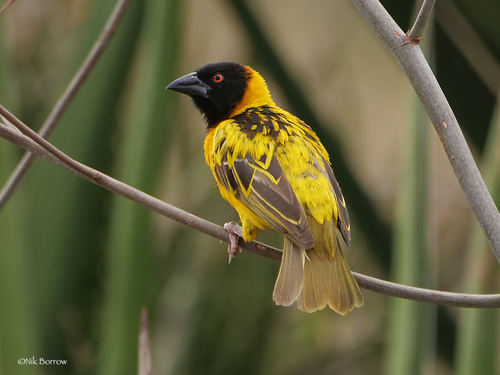
Ploceus cucullatus, the village weaver, is a stocky bird that measures 15–17 cm (5.9–6.7 in) long. It has a strong conical bill and dark reddish eyes. Across its range, breeding males have distinct plumage patterns. In the northern part of the species' range, breeding males have a black head edged with chestnut, which is typically most distinct on the nape and chest. Moving toward the southern part of the range, the amount of black and chestnut plumage decreases. Breeding males of the southernmost subspecies only have black on the face and throat, with yellow nape and crown. For all subspecies, breeding males have a black bill, black and yellow upperparts and wings, and yellow underparts. Nonbreeding males have a yellow head with an olive crown, grey upperparts, and whitish underparts, while their wings remain yellow and black. Adult females have streaked olive upperparts, yellow and black wings, and pale yellow underparts. Young birds resemble adult females but have browner backs. This is one of the more common weaver species, widespread across sub-Saharan Africa, though it is not found in arid regions of the southwest and northeast. It has been introduced to islands in the Indian Ocean and the Caribbean, where it has adapted well to climates similar to its native range. Village weavers forage and roost in large groups, often mixing with other weaver species. In some areas, they move periodically along fixed routes. They search for food on the ground, and also search through vegetation and trees above ground. They nest in colonies and are very active during the breeding season. Birds constantly enter and leave the colony, creating significant noise. Colonies can hold up to 150 nests in a single tree, but 8 to 100 nests per tree is typical. A village weaver's nest is 14–17 cm (5.5–6.7 in) long and 11–13 cm (4.3–5.1 in) high. Its entrance is usually extended into a tube 4–8 cm (1.6–3.1 in) long. Males weave the nest structure using long leaf strips torn from palms or large grass species such as Arundo donax. The nest is roofed, and shaped ovoid or kidney-shaped. Internally, it contains a nesting chamber separated by a ground sill from an antechamber, with the main nest entrance located at the bottom of the antechamber. The inner ceiling is made from inserted, not woven, strips of grass or other leaves. The inner floor is lined with short thatched strips of palm, grass blades or heads, and feathers. Building a nest requires approximately 300 long leaf strips, which the male tears off and transports one at a time. The male gathers building material throughout the construction process, and keeps his feet in the exact same position while maintaining the same orientation the entire time he works. He begins by creating an attachment, weaving around usually two hanging branches just below a fork, with one foot on each branch. He incorporates these branches into a ring he constructs by weaving in the plane of the branches at the edge of his reach. Next, he extends the high end of the ring in front of his head, working gradually toward his feet to build a half-globe that forms the nesting chamber. The male then constructs the roof of the antechamber, working over his head. After this, he lines the ceiling and builds the entrance tube, hanging upside down while still keeping his feet in the same spots. The weaving technique works as follows: the male seizes a strip near its end, doubles the strip back on itself, then pokes the end into his previous work with a vibrating movement until it sticks. He releases the strip, moves his head to the opposite side of the nest wall, seizes the strip again, and pokes it through in a new spot. He repeats this process, regularly reversing the direction he weaves the strip, poking and pulling the strip through holes until the entire length of the strip is used. Females also collect material, but only work on lining the nesting cup.