About Ploceus baglafecht (Daudin, 1802)
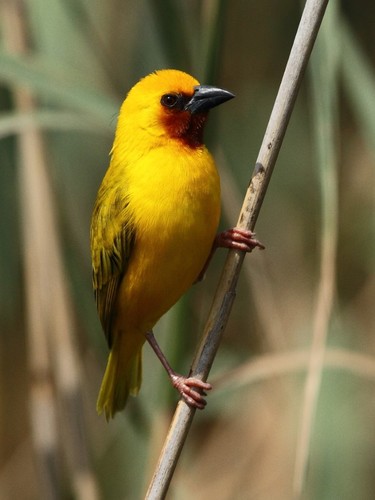
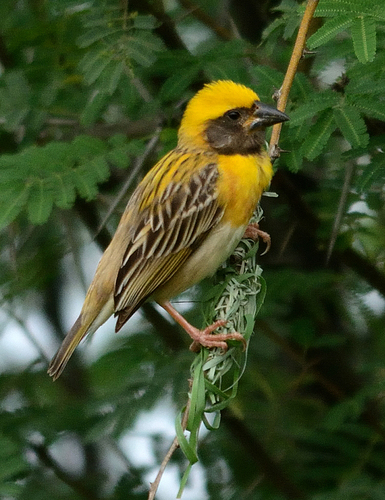
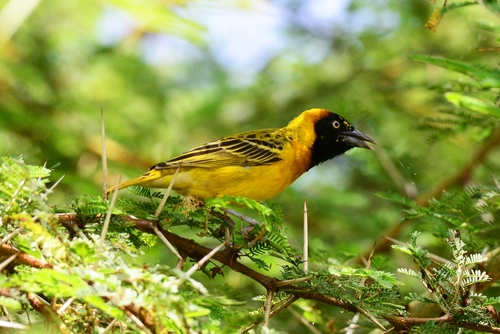
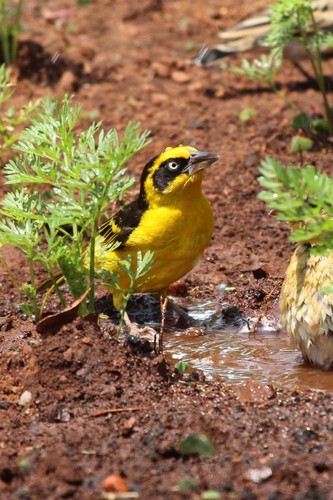
The baglafecht weaver, scientific name Ploceus baglafecht (Daudin, 1802), has a total body length of 15 cm (5.9 in). Adult males have a distinctive black mask that extends from the bill through the eye to the ear coverts, which contrasts with the bright yellow forehead, forecrown, and throat. Their upperparts are yellowish green, with dark feather centers that create faint streaking. The underparts are bright yellow on the breast, fading to white closer to the vent. Their tail is yellow with a dark brown wash; the bill is black, and the eye is pale yellow. Females do not have a black mask, but have dusky lores and a yellowish-green cap that matches the color of their upperparts. In non-breeding plumage, the mask is mostly lost, but a dusky area around the eye remains; the upperparts including the crown are greyish brown, and the underparts are white with a buff wash. Juveniles and immature birds have a dark yellowish green head with no mask. The nominate race and Emin's weaver develop a distinct non-breeding plumage, but Reichenow's weaver does not. This species is found in central, eastern, and south-eastern Africa, where it inhabits forest edges, woodlands, gardens, and towns. In terms of behaviour and ecology, the baglafecht weaver normally breeds singly instead of in colonies. Its nests are loosely woven, and are usually placed in the foliage of trees or bushes. It is often aggressive toward other birds and is not shy of people.