About Ploceus aurantius (Vieillot, 1805)
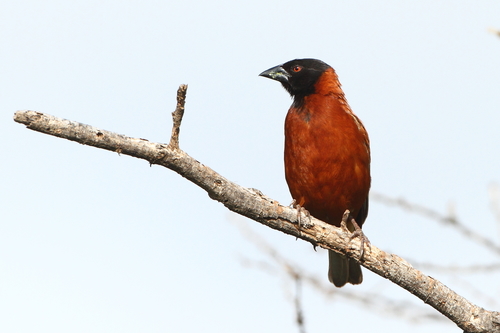
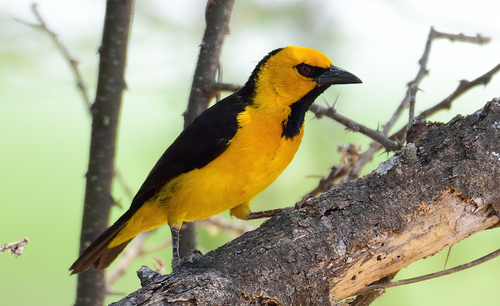
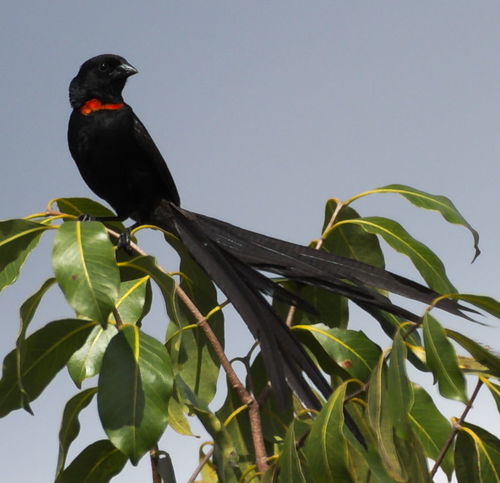
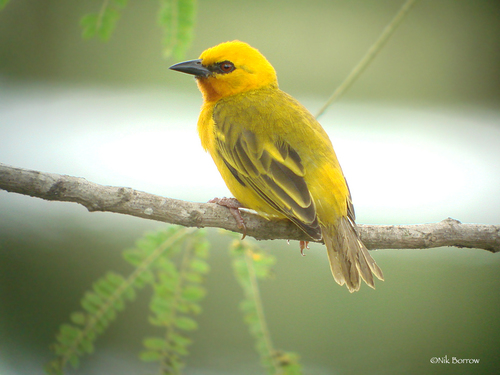
This species, commonly called the orange weaver, can reach a total length of about 12.5 centimetres (4.9 inches) including the tail. Orange weavers display sexual dimorphism, and their plumage also changes with the season. During the breeding (or "nuptial") season, the male has a black beak, a small patch of black skin located both in front of and behind the eyes that gives the eyes an oval appearance, and brown wings. The rest of the male's breeding plumage is a brilliant red to orange color. For this species overall, the bill is pale and slender, while the eyes are either reddish-brown or pale grey. Outside of the breeding season, males have much drabber plumage: they are brown overall with some dark streaks and a cream-colored belly. Females retain the same plumage year-round, and this plumage matches the appearance of non-breeding males. Breeding-season male orange weavers are often mistaken for males of another species, Euplectes orix, commonly known as the southern red bishop, though southern red bishop males have a black belly, unlike orange weavers. The orange weaver is found in western and central Africa. It inhabits mangroves, thickets, and swamps in coastal lagoons and along major West African rivers. In the wild, orange weavers are polygamous, with each male typically mating with two or three females. They build their nests in reed beds located close to the water surface. Like most other finches, orange weavers are colonial nesters; some sites hold hundreds of complexly woven nests, built on palms, reeds, and other trees. Orange weavers feed mainly on fruit and seeds, but also eat insects including locusts, beetles, and caterpillars. They are usually seen in pairs or small groups. Males construct an ovoid nest using grass and palm strips. Females lay two eggs and handle incubation.