About Plocamopherus pecoso Vallès & Gosliner, 2006
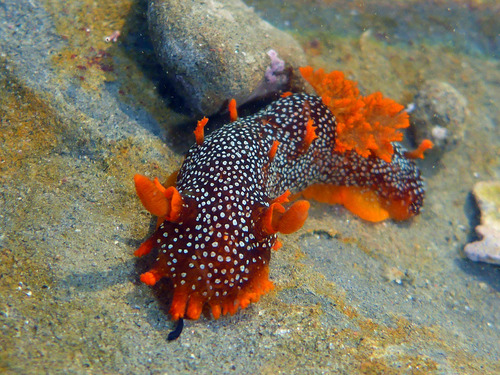
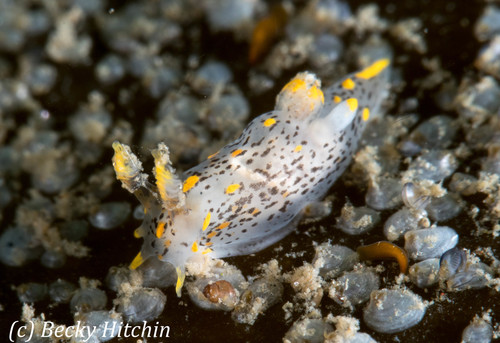
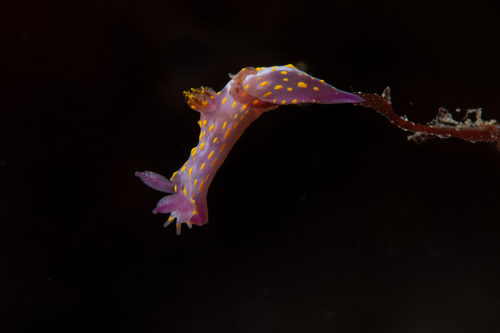
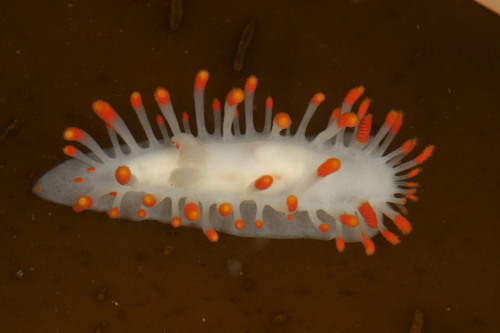
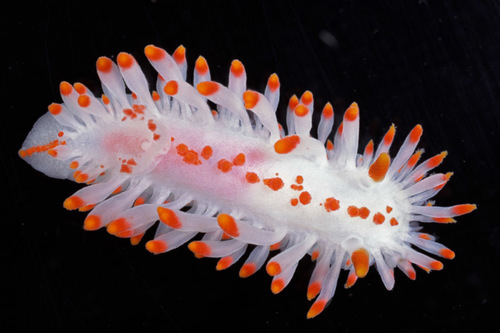
When alive, Plocamopherus pecoso has an elongate, limaciform body shape with a rounded anterior end. Its head has a fringed oral veil that carries eight short, small, ramified appendages. The oral tentacles of this species are flat. The body has a transparent white base color, and is heavily covered all over with small orange speckles. These orange dots become much larger and less numerous at the base of the foot. Minute brown dots have been observed surrounding the base of the lateral appendages and along the keel; in other specimens of this species, these brown dots are present across the entire body. White dots are typically located on the notum, arranged in a non-continuous line along the margin of both sides of the animal, and this line joins behind the branchial gills. White dots are also found along the margin of the fringed oral veil, on the tip of the tail, on the tips of the branchiae, the clavus of the rhinophores, dorsal tubercles, and oral veil appendages, where they are slightly larger and less abundant. The long rhinophores are translucent, and speckled with brown on both the peduncle and clavus. A single white spot sits at the tip of the clavus, and the rhinophoral sheath is long. This species has three pairs of short lateral appendages; the two posterior pairs have a prominent, brown, rounded globular structure. The rearmost pair usually has the largest globular structure, though exceptions to this have been observed. All lateral appendages are slightly ramified, and whitish at the tip. There are three main tripinnate branchial leaves, which do not form a complete circle around the anus. The posterior portion of the foot forms a well-developed keel that has a small crest with a white tip. This species was first described from Luzon in the Philippines, and has only ever been found at other locations within the Philippines.