About Plocamopherus maderae (R.T.Lowe, 1842)
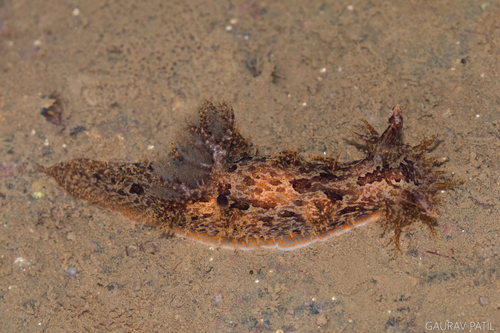
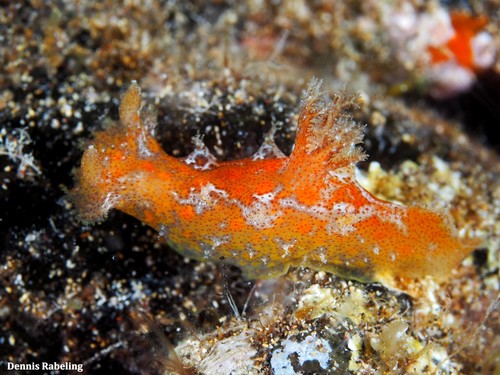
This species of nudibranch, Plocamopherus maderae, has an orange or yellow-orange body covered in numerous small dark brown spots, along with fewer, larger, poorly defined orange spots and patches. The mantle edge bears three pairs of branched papillae: one behind the branchial plume, one in front of it, and one halfway along the back. These papillae are marked with white pigment, and a variable amount of white pigment is also present along the mantle edge and behind the gills. The papillae located behind the branchial plume hold rounded bioluminescent organs. The tail of this nudibranch is long, flattened, and has a dorsal crest; it is muscular and can be used for swimming. Its gills are large, sparsely branched, and held upright. The rhinophores have lamellate tips and tapering stalks, and match the body's colour. This species reaches a maximum total size of around 50 millimetres. It is typically nocturnal, and spends the daytime hiding underneath boulders in shallow water. Plocamopherus maderae was first described from specimens collected in Madeira. It has since been reported from the Canary Islands and the Cape Verde Islands.